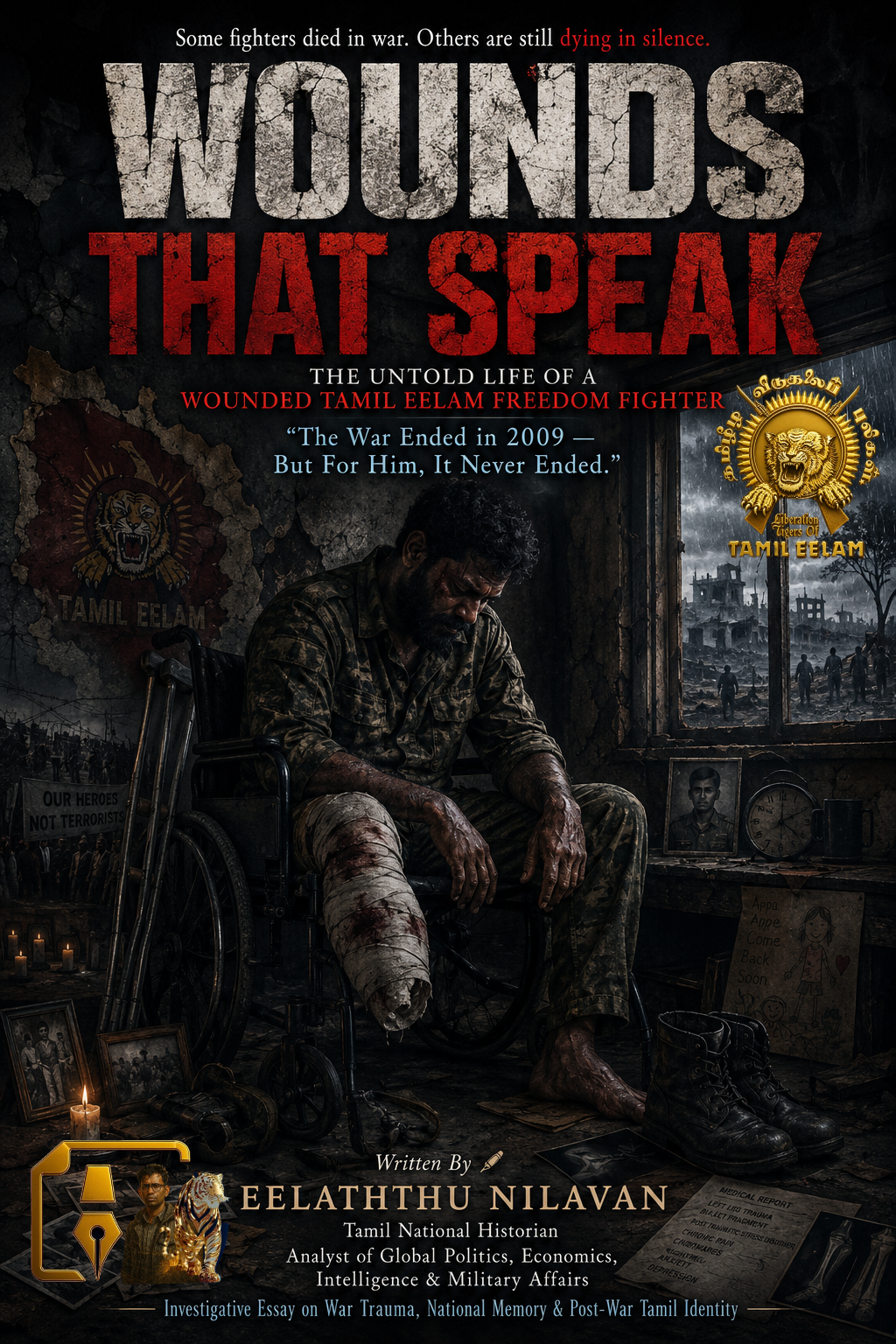

The Untold Life of a Wounded Tamil Eelam Freedom Fighter
The Invisible War After the Guns Fell Silent
◤ INTRODUCTION: THE SIDE OF WAR HISTORY TRIED TO BURY ◢
War is often remembered through dramatic images — gunfire tearing through the night sky, fallen fighters wrapped in flags, heroic last stands immortalised in songs and speeches. Nations build monuments for the dead. Political movements glorify sacrifice. History records victories and defeats.
But there exists another battlefield that history rarely acknowledges.
It is the battlefield inside the bodies and minds of those who survived.
The wounded Tamil Eelam freedom fighter stands as one of the most abandoned figures of the post-war era. He did not receive the “honour” of martyrdom. He survived. And survival became his punishment.
The war may have officially ended in 2009, but for thousands of wounded fighters, the war merely changed form. The explosions stopped outside — and began inside them.
This is not simply a story about injury.
It is the anatomy of slow destruction.
The shattered bones, the broken nervous systems, the collapsing families, the political abandonment, the cultural erasure, and the silent psychological decay together form an “Invisible War” that continues long after the battlefield disappeared.
The wounded fighter became a living graveyard of memory — carrying within him the unresolved pain of an entire nation.
THE WOUNDED BODY — WHERE THE REAL WAR BEGAN
◤ Flesh Remembers What Nations Try to Forget ◢
The human body is not designed for war. Yet war leaves its signature permanently carved into flesh.
Many Tamil fighters returned from the battlefield carrying catastrophic injuries:
• shattered spinal cords,
• amputated limbs,
• embedded shrapnel,
• damaged eyesight,
• hearing loss,
• neurological trauma,
• and permanent paralysis.
For some, every movement feels like reopening an old wound.
A bullet may leave the body in seconds, but its consequences remain for decades.
A fighter who once carried weapons through jungles now struggles to lift a cup of water. A man who once commanded units can no longer climb stairs without assistance. Another who survived shelling can no longer recognise his own reflection due to burns and deformities.
War transforms the body into a prison.
The cruellest part is that society often believes survival means recovery. But survival is not healing.
The wounded fighter wakes each morning to continue a battle his dead comrades escaped forever.
His scars are not symbols of glory.
They are permanent testimonies of violence.
◤ The Brain: The Battlefield That Never Heals ◢
Some wounds cannot even be seen.
Brain trauma has destroyed speech patterns, memory functions, emotional regulation, and cognitive stability in countless survivors.
A fighter may appear physically alive while mentally trapped in fragments of the past.
A loud sound becomes artillery fire.
A sudden flash becomes an airstrike.
A nightmare becomes reality again.
Psychological injury is often more devastating than physical injury because it isolates the victim inside his own mind.
The world sees silence.
Inside him, the war screams endlessly.
THE INVISIBLE WAR — THE COLLAPSE OF THE INNER WORLD
◤ PTSD and the Endless Return of Death ◢
Post-traumatic stress disorder is not merely fear. It is the inability to escape memory.
Every dead comrade returns at night.
The wounded fighter relives:
• the screams of civilians,
• the smell of burned flesh,
• the cries of children,
• the final breaths of friends,
• and the unbearable helplessness of defeat.
Sleep becomes dangerous.
Many survivors avoid silence because silence allows memory to speak.
Others isolate themselves completely, unable to explain their suffering to those who have never witnessed war.
The psychological burden becomes unbearable because there is no national mechanism to absorb their pain. No truth commissions. No mass rehabilitation. No societal mourning process.
The trauma remains trapped inside individuals rather than being collectively acknowledged.
As a result, the fighter becomes emotionally stranded between two worlds:
• unable to return to the past,
• and unable to belong to the present.
◤ Survivor’s Guilt: The Cruel Punishment of Survival ◢
One of the darkest psychological burdens is survivor’s guilt.
The wounded fighter constantly asks:
“Why did I survive when better men died?”
This question destroys identity from within.
The dead are remembered as heroes.
The living are haunted as failures.
A martyr receives honour.
A survivor receives silence.
This inversion creates profound emotional collapse. Many wounded fighters secretly believe death would have been kinder.
For them, life itself became the unfinished punishment of war.
FROM HERO TO BURDEN — THE SOCIAL ABANDONMENT OF THE WOUNDED
◤ Society Celebrates Sacrifice — But Rejects Suffering ◢
During wartime, the fighter represented courage, sacrifice, and national resistance.
After the war, he became inconvenient.
Communities that once praised resistance now avoid confronting the human cost of that resistance.
People whisper:
• “Why doesn’t he work?”
• “Why is he always at home?”
• “Why can’t he move on?”
Such questions reveal a society desperate to escape memory.
The wounded fighter becomes a living reminder of unresolved history — and therefore many prefer not to see him at all.
This creates social exile.
Friends disappear.
Relatives grow distant.
Employers refuse opportunities.
Communities become emotionally cold.
The fighter who once protected society now feels abandoned by it.
◤ Economic Destruction and Structural Neglect ◢
Most wounded fighters live under severe economic hardship.
Without:
• adequate healthcare,
• disability support,
• rehabilitation programs,
• trauma counselling,
• or stable employment,
They become trapped in cycles of poverty and dependency.
The destruction is not accidental. It reflects a larger political reality: the systematic dismantling of collective Tamil resilience after the war.
A physically weakened population is easier to politically silence.
Thus, the wounded fighter becomes not merely a victim of war, but also a victim of post-war structural abandonment.
HOME AS A SECOND BATTLEFIELD
◤ The Collapse of Family Stability ◢
War does not end at the frontlines.
It enters homes silently.
The wounded fighter often watches his family slowly collapse under emotional and financial pressure.
His spouse becomes caregiver, nurse, emotional support system, and economic provider simultaneously. Exhaustion breeds frustration. Frustration breeds distance.
Children grow up witnessing trauma they cannot understand.
Communication dies slowly.
The household becomes filled with:
• silence,
• suppressed anger,
• emotional withdrawal,
• and grief without language.
The fighter suffers not only because he is wounded, but because he watches those he loves suffer beside him.
This creates unbearable guilt.
He begins believing his own existence has become a burden to his family.
Thus, the home transforms into another battlefield — one fought without bullets, but equally destructive.
THE DIGITAL ERA AND THE FRAGMENTATION OF THE TAMIL NATIONAL SOUL
◤ Horizontal Violence and Internal Collapse ◢
After 2009, the battlefield shifted into digital space.
Social media became both a tool of expression and a weapon of internal destruction.
Unable to confront state power directly, frustration increasingly turned inward.
This phenomenon — often described as Horizontal Violence — occurs when oppressed communities redirect pain toward one another instead of confronting the structures causing that pain.
As a result:
• public shaming,
• character assassinations,
• ideological purity tests,
• internal factionalism,
• and emotional cannibalism
have become normalised.
The enemy no longer needs to divide the people externally.
The fragmentation now occurs internally.
This constant self-destruction weakens collective political consciousness and exhausts emotional energy that could otherwise sustain national survival.
◤ The Rise of the Mercenary Mindset ◢
Another devastating transformation has emerged: the replacement of collective nationalism with individual survivalism.
Many now pursue:
• status,
• luxury,
• personal branding,
• and political convenience
while distancing themselves from historical responsibility.
The struggle becomes commodified.
Sacrifice becomes transactional.
Historical memory becomes negotiable.
A “broker culture” emerges in which some individuals trade collective pain for personal advancement.
This destroys trust — the essential foundation of any national movement.
No nation can survive if its people begin treating collective suffering as a private opportunity.
THE CULTURAL ORPHANING OF THE NEXT GENERATION
◤ A Generation Raised Without Historical Anchors ◢
One of the greatest dangers facing Eelam Tamils today is not military defeat — but cultural disconnection.
Many young Tamils inherit fragments of identity without understanding the deeper historical reality behind them.
They know slogans but not sacrifice.
Symbols but not suffering.
Emotion, but not historical context.
Social media fame increasingly replaces cultural responsibility.
The next generation risks becoming culturally rootless: Tamil in appearance, but disconnected from collective historical consciousness.
Without historical grounding, assimilation accelerates.
And when a people lose historical memory, they become vulnerable to ideological manipulation, political fragmentation, and cultural disappearance.
POLITICAL SILENCE AND THE BETRAYAL OF MEMORY
◤ Memorial Politics Without Living Responsibility ◢
Political leaders frequently praise dead martyrs because the dead make no demands.
But the wounded living survivor demands uncomfortable accountability.
Thus:
• memorial ceremonies continue,
• speeches continue,
• slogans continue,
while wounded fighters remain abandoned.
This contradiction reveals a painful truth: many institutions prefer symbolic nationalism over practical responsibility.
The wounded body exposes the unfinished reality of the struggle.
And that reality threatens political convenience.
So society glorifies the dead while hiding the living.
THE LIVING MARTYR — HISTORY’S MOST UNCOMFORTABLE WITNESS
◤ The Human Archive of a Nation’s Pain ◢
The wounded fighter is more than an individual.
He is a living historical archive.
His body contains:
• the memory of war,
• the evidence of sacrifice,
• the failures of leadership,
• and the unfinished demands of justice.
Every scar is political testimony.
Every tremor of trauma is historical evidence.
To ignore him is to erase truth itself.
The dead can become mythologised.
But the living wounded survivor cannot be romanticised so easily.
He forces society to confront consequences rather than slogans.
That is why he is often hidden from public consciousness.
CONCLUSION — A PEOPLE WHO FORGET THEIR WOUNDED FORGET THEMSELVES
◤ The Final Warning of the Invisible War ◢
The greatest danger facing a wounded nation is not external destruction alone.
It is internal forgetting.
When a society abandons:
• it’s wounded,
• its memory,
• its collective responsibility,
• and its historical truth,
It begins dissolving from within.
The wounded Tamil Eelam freedom fighter stands today as a symbol of unfinished history.
He survived the battlefield.
But survival became a slower form of death.
His wounds still speak.
The question is whether society is willing to listen.
Because if these voices disappear into silence, an entire people may lose not only their history, but their soul.
“Death ended the suffering of many.
But for the wounded survivor, suffering became life itself.”

𝐖𝐫𝐢𝐭𝐭𝐞𝐧 𝐛𝐲: 𝐄𝐞𝐥𝐚𝐭𝐡𝐭𝐡𝐮 𝐍𝐢𝐥𝐚𝐯𝐚𝐧
Tamil National Historian | Analyst of Global Politics, Economics, Intelligence & Military Affairs
09/05/2026
The views expressed in this article are the author’s own and do not necessarily reflect Amizhthu’s editorial stance.