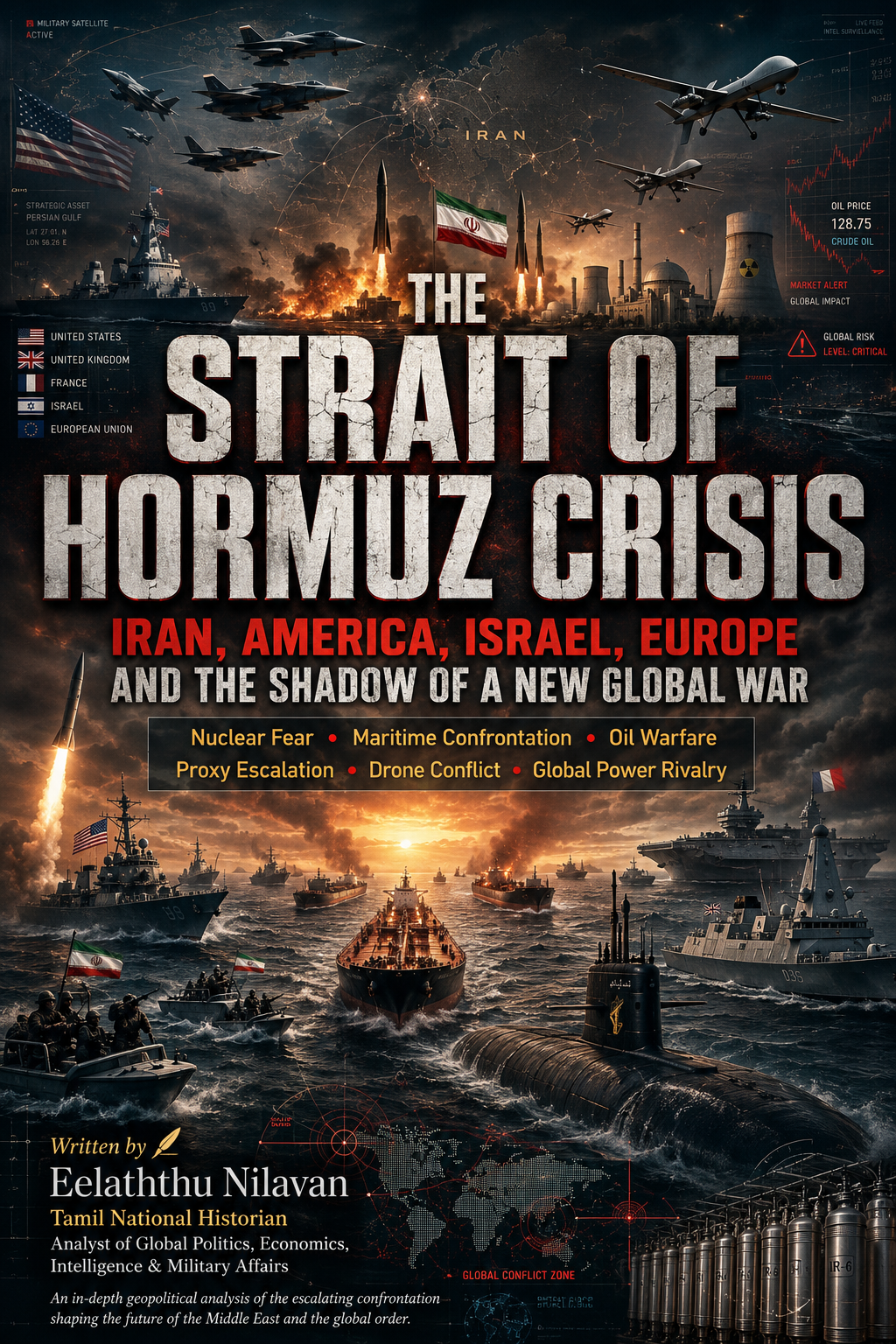

Nuclear Fear • Maritime Confrontation • Oil Warfare • Proxy Escalation • Global Power Politics
INTRODUCTION — THE WORLD’S MOST DANGEROUS WATERWAY IS ON EDGE
The Strait of Hormuz has once again emerged as the epicentre of global geopolitical tension. Stretching between Iran and the Arabian Peninsula, this narrow maritime corridor carries nearly one-fifth of the world’s oil supply. Any instability in these waters immediately reverberates through global energy markets, financial systems, military alliances and diplomatic relations.
Today, the crisis is no longer limited to economic pressure or naval intimidation. It has evolved into a multidimensional confrontation involving nuclear stockpiles, covert military preparations, drone warfare, sanctions, cyber-intelligence operations, maritime blockades and the threat of unconventional retaliation.
Iran’s leadership now openly warns that future wars will unfold in “unexpected arenas.” Washington accuses Tehran of expanding its missile and drone infrastructure. European powers are mobilising naval assets. China has become entangled in sanctions and alleged technological cooperation with Tehran. Meanwhile, Israel remains a silent but highly influential actor behind the strategic calculations shaping the region.
The current confrontation resembles not merely a regional dispute but the early architecture of a broader geopolitical realignment.
IRAN’S “FULL READINESS” DOCTRINE
Preparing for a Hidden War
Iranian military officials have declared that all critical nuclear infrastructure has entered a state of “full readiness.” According to senior commanders, Tehran anticipated the possibility of covert American or Israeli heliborne raids designed to seize or destroy enriched uranium stockpiles.
This statement reveals a profound shift in Iranian strategic thinking.
For years, Iran primarily focused on defending against airstrikes and missile attacks. Today, however, Tehran appears increasingly concerned about highly specialised infiltration missions involving helicopters, commandos, sabotage teams and intelligence operatives.
Iran claims it has deployed both the regular Iranian Army and the Islamic Revolutionary Guard Corps (IRGC) around sensitive facilities. Reports also indicate that abandoned airports and isolated runways have been intentionally damaged to prevent their use by hostile forces during surprise insertions.
This reflects lessons learned from previous Israeli operations inside Iran, including assassinations of nuclear scientists, sabotage at Natanz and covert intelligence penetrations that deeply embarrassed Iranian security institutions.
Tehran’s current doctrine appears designed to ensure that no foreign force can rapidly capture nuclear material without triggering large-scale retaliation.
THE COLLAPSE OF TRUST BETWEEN IRAN AND THE IAEA
From Nuclear Monitoring to Political Confrontation
Iran’s relationship with the International Atomic Energy Agency (IAEA) has deteriorated sharply.
Tehran accuses the agency of exceeding its technical mandate and behaving as a political instrument of Western powers. Iranian officials argue that the IAEA should focus exclusively on nuclear inspections rather than commenting on missile development, regional security or maritime activities in the Persian Gulf.
This growing hostility is extremely significant.
For decades, the IAEA functioned as one of the few remaining bridges between Iran and the international system. Even during periods of extreme tension, the agency maintained channels of verification and communication.
Now, however, Iranian officials increasingly portray international inspections as potential intelligence-gathering mechanisms for future military strikes.
This erosion of trust creates a dangerous vacuum. Without credible monitoring mechanisms, the international community loses visibility into Iran’s nuclear activities, while Tehran becomes more paranoid about espionage and sabotage.
The result is a classic security dilemma: every defensive action by one side appears offensive to the other.
TRUMP’S HARDLINE POSITION AND THE DIPLOMATIC DEADLOCK
Why Negotiations Are Failing
President Donald Trump has reportedly rejected Iran’s latest ceasefire and de-escalation proposals, describing them as “totally unacceptable.”
At the heart of the disagreement lies Iran’s enriched uranium stockpile.
Washington demands long-term guarantees regarding Tehran’s nuclear capabilities, including strict commitments concerning enrichment levels, storage sites and transparency. Iran, however, insists that current negotiations should focus only on ending hostilities and reducing military escalation.
Tehran has established a clear “red line”: it refuses to integrate broader nuclear concessions into emergency ceasefire discussions.
This stalemate illustrates a deeper structural problem.
The United States seeks a comprehensive strategic rollback of Iranian power, while Iran seeks limited negotiations focused on immediate conflict management without surrendering its long-term deterrence capabilities.
Neither side currently appears willing to compromise.
THE STRAIT OF HORMUZ — THE WORLD’S ENERGY HEARTBEAT
Why the Entire Planet Is Watching
The Strait of Hormuz is arguably the most strategically important maritime chokepoint on Earth.
Nearly 20% of global oil exports and major liquefied natural gas shipments pass through this narrow waterway every day. Even temporary disruptions can trigger massive increases in oil prices, inflationary shocks and supply-chain instability across Asia, Europe and North America.
Recent military incidents in the Gulf have already shaken global markets.
Reports of tanker seizures, drone attacks, naval interceptions and submarine deployments have raised fears that a single miscalculation could ignite a much wider war.
The successful passage of a Qatari LNG tanker through the strait was interpreted internationally as a small but symbolically important sign that maritime traffic remains possible despite escalating tensions.
However, the overall environment remains extremely volatile.
Insurance costs for commercial shipping continue to rise. Energy traders remain nervous. Gulf monarchies fear being dragged into confrontation between Tehran and Washington.
BRITAIN, FRANCE AND THE RETURN OF EUROPEAN GUNBOAT DIPLOMACY
The Deployment of HMS Dragon
Britain’s decision to deploy the HMS Dragon to the Middle East signals Europe’s growing military involvement in the Gulf crisis.
The advanced Type 45 destroyer specialises in missile defence and air-policing operations, making it highly suitable for escort missions through contested waters.
At the same time, France has reportedly moved the Charles de Gaulle carrier strike group into the Red Sea.
Together, Britain and France appear to be preparing the foundations of a future multinational maritime coalition aimed at protecting shipping routes and reassuring global energy markets.
More than 40 countries are reportedly participating in discussions regarding future Hormuz security operations involving escort missions, mine-clearing capabilities and aerial surveillance.
This represents the largest potential European naval coordination effort in the Gulf in many years.
However, European governments face a difficult balancing act.
They seek to protect international commerce without appearing fully subordinate to Washington’s confrontational strategy toward Iran.
THE SHADOW WAR BETWEEN IRAN AND ISRAEL
The Conflict Behind the Conflict
Although Israel is not always publicly visible in the latest Gulf developments, it remains central to the strategic equation.
Israeli intelligence and military doctrine have long focused on preventing Iran from achieving nuclear weapons capability. Israeli operations inside Iran over the past decade have included cyberattacks, assassinations and sabotage campaigns targeting nuclear infrastructure.
Iran’s recent emphasis on defending against covert raids strongly suggests fear of future Israeli special operations.
Tehran believes Israel may attempt precision strikes or clandestine seizure missions aimed at neutralising sensitive nuclear material before Iran can achieve irreversible nuclear capability.
Meanwhile, Israel views Iran’s expanding drone networks, missile programs and proxy alliances as existential threats.
This invisible confrontation continues to shape the military calculations of both Washington and Tehran.
CHINA ENTERS THE CRISIS THROUGH SANCTIONS AND TECHNOLOGY
The Expanding Geopolitical Triangle
The United States has now imposed sanctions on several mainland Chinese and Hong Kong-based companies accused of assisting Iran’s drone and missile programs.
Washington alleges that these firms provided specialised components, industrial materials and satellite support connected to Iranian military operations.
The sanctions arrive just before a major summit between Xi Jinping and Donald Trump, adding new friction to already strained U.S.-China relations.
This development reveals how the Gulf crisis is no longer merely regional.
It is increasingly tied to the larger strategic rivalry between the United States and China.
Beijing continues to purchase Iranian oil despite American pressure campaigns, while Chinese firms allegedly provide technological pathways that help Tehran circumvent Western sanctions.
The result is the emergence of a broader geopolitical axis linking energy security, sanctions warfare and technological competition.
IRAN’S “DOLPHIN” SUBMARINES AND ASYMMETRIC NAVAL WARFARE
The Ghadir-Class Threat
Iran’s deployment of domestically built Ghadir-class submarine vessels into operational positions inside the Strait of Hormuz marks a major escalation in asymmetric naval strategy.
These small submarines are optimised for shallow-water warfare.
Unlike large nuclear submarines, the Ghadir-class vessels can hide near the seabed, remain stationary for extended periods and ambush larger ships in confined waterways.
Iranian commanders refer to them as the “Dolphins of the Persian Gulf” because of their rapid surfacing and diving abilities.
Military analysts warn that these submarines represent a serious threat precisely because they are difficult to detect in the crowded, shallow and noisy waters of the Gulf.
Even a limited underwater clash could severely disrupt global shipping.
The deployment demonstrates Tehran’s broader military philosophy: instead of matching Western navies ship-for-ship, Iran seeks to impose strategic costs through stealth, unpredictability and localised disruption.
THE POSSIBILITY OF “UNEXPECTED ARENAS”
Iran’s Warning to the West
Iranian officials repeatedly warn that future conflict will expand into “arenas the enemy has not anticipated.”
This phrase likely refers to several possibilities:
• Cyber warfare against Western infrastructure
• Proxy militia attacks across the Middle East
• Maritime sabotage operations
• Drone strikes on Gulf energy facilities
• Disruption of global shipping lanes
• Escalation through allied regional networks
Iran’s strategic doctrine increasingly emphasises distributed retaliation rather than conventional battlefield confrontation.
Instead of fighting symmetrically against American military superiority, Tehran seeks to stretch conflict across multiple domains and geographic theatres.
This creates enormous uncertainty for Western planners.
The danger is not necessarily a massive conventional war, but rather a cascading series of smaller confrontations that can spiral out of control.
GLOBAL CONSEQUENCES — OIL, ECONOMICS AND THE RISK OF WORLDWIDE INSTABILITY
Why This Crisis Matters Beyond the Middle East
The Hormuz crisis carries implications far beyond regional politics.
A prolonged disruption in Gulf shipping could trigger:
• Global oil price spikes
• Inflation across Europe and Asia
• Supply-chain breakdowns
• Financial market instability
• Energy shortages in vulnerable economies
• Military escalation among major powers
Asian economies such as China, India, Japan and South Korea remain heavily dependent on Gulf energy imports.
European governments fear renewed economic shocks after years of instability caused by pandemic disruptions and the Ukraine conflict.
Meanwhile, Washington views uninterrupted maritime access as essential to maintaining global strategic credibility.
The Strait of Hormuz is therefore not merely a regional flashpoint.
It is one of the critical pressure valves of the global system itself.
CONCLUSION — A REGION STANDING AT THE EDGE
The current confrontation surrounding Iran, the United States and the Strait of Hormuz reflects a dangerous convergence of nuclear tension, military escalation, energy insecurity and great-power rivalry.
Diplomatic trust has nearly collapsed.
Military deployments continue expanding.
Proxy threats multiply across the region.
And every naval manoeuvre now carries the risk of catastrophic miscalculation.
At the centre of the crisis lies a fundamental question:
Can diplomacy still restrain the accelerating logic of confrontation, or has the Middle East already entered the opening stages of a new era of permanent geopolitical conflict?
The answer may determine not only the future of the Gulf, but the stability of the global order itself.

𝐖𝐫𝐢𝐭𝐭𝐞𝐧 𝐛𝐲: 𝐄𝐞𝐥𝐚𝐭𝐡𝐭𝐡𝐮 𝐍𝐢𝐥𝐚𝐯𝐚𝐧
Tamil National Historian | Analyst of Global Politics, Economics, Intelligence & Military Affairs
12/05/2026
The views expressed in this article are the author’s own and do not necessarily reflect Amizhthu’s editorial stance.