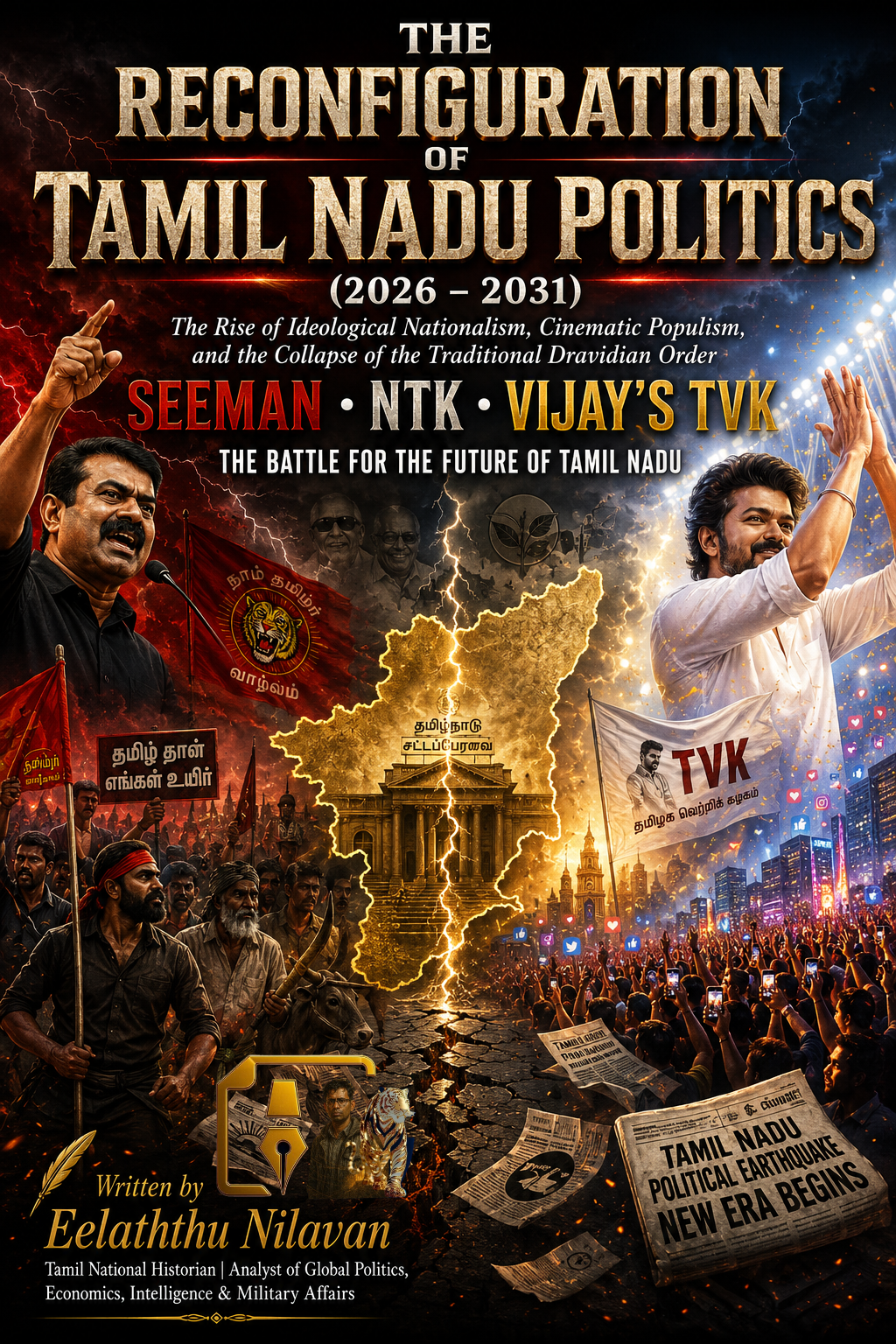
𝑨 𝑷𝑶𝑳𝑰𝑻𝑰𝑪𝑨𝑳 𝑩𝑨𝑻𝑻𝑳𝑬 𝑭𝑶𝑹 𝑻𝑯𝑬 𝑭𝑼𝑻𝑼𝑹𝑬 𝑶𝑭 𝑻𝑨𝑴𝑰𝑳 𝑵𝑨𝑫𝑼
The Rise of Ideological Nationalism, Cinematic Populism, and the Collapse of the Traditional Dravidian Order
A POLITICAL CIVILIZATION AT THE EDGE OF TRANSFORMATION
Tamil Nadu has entered one of the most volatile and historically significant political transitions since the collapse of the MGR–Karunanidhi era. The 2026 Assembly Election did not merely produce a fragmented verdict; it exposed the exhaustion of the traditional Dravidian binary while simultaneously unveiling a new axis of political competition. In this transformed landscape, the central question is no longer whether the DMK or AIADMK will dominate Tamil Nadu, but rather whether the future belongs to the cinematic populism of Vijay’s Tamizhaga Vettri Kazhagam (TVK) or the ideological nationalism of Seeman’s Naam Tamilar Katchi (NTK).
The election results revealed multiple political truths operating simultaneously. TVK emerged as the single largest force riding a massive anti-establishment wave, yet it failed to secure an outright majority. NTK, despite retaining a committed ideological base of nearly two million voters, suffered a visible electoral slowdown. Meanwhile, the traditional Dravidian giants were pushed into defensive positions, struggling to maintain relevance in a rapidly changing political culture.
This moment, therefore, represents not merely an election cycle but the beginning of a structural reordering of Tamil political identity itself.
THE ILLUSION OF NTK’S DECLINE
A Setback Misread as Collapse
To casual observers, the electoral performance of NTK appeared disappointing. After years of aggressive mobilisation, ideological campaigns, and relentless activism, the party’s vote share remained around four per cent. Critics interpreted this as proof that Seeman’s political project had reached its ceiling.
Yet such interpretations overlook the structural nature of NTK’s movement.
Unlike personality-driven parties that collapse once charisma fades, NTK possesses a deeply ideological organisational spine. Its support base is not built purely on welfare promises or cinematic attraction but on a sustained emotional appeal rooted in Tamil nationalism, ecological politics, linguistic identity, and anti-establishment sentiment. That ideological depth provides resilience even during electoral stagnation.
The party’s current condition is therefore better understood as strategic fatigue rather than ideological irrelevance.
For more than a decade, NTK functioned as a permanent protest machine. Its cadres participated in environmental struggles, anti-mining campaigns, farmer protests, language-rights activism, labour movements, and memorial politics connected to Eelam Tamil identity. This relentless mobilisation created visibility but also exhaustion. The election exposed the limits of activism without parallel institutional expansion.
However, electoral slowdown does not automatically translate into ideological collapse. In fact, the existence of a stable two-million-vote core demonstrates that NTK has crossed the threshold from temporary movement into permanent political presence.
THE “VIJAY WAVE” AND THE REARRANGEMENT OF ELECTORAL MATHEMATICS
Cinema, Aspiration, and the Desire for Winnable Change
The rise of Vijay’s TVK altered Tamil Nadu’s political arithmetic in ways that traditional parties underestimated.
The so-called “Vijay Wave” was not simply the product of celebrity worship. It represented the convergence of several emotional and political forces:
• anti-incumbency anger,
• frustration with Dravidian stagnation,
• youth disillusionment,
• social media-driven emotional mobilisation,
• and the search for a fresh political instrument.
What makes TVK particularly significant is its ability to absorb floating voters across caste and ideological lines. Vijay’s appeal functioned as a cultural umbrella broad enough to attract urban youth, middle-class aspirants, cinema fans, soft nationalists, and even sections of voters previously sympathetic to NTK.
This shift exposed an important psychological transformation in Tamil Nadu’s electorate.
Many voters who emotionally agreed with NTK’s ideological critiques nevertheless voted for TVK because they perceived Vijay as more “electable.” In essence, the electorate temporarily prioritised practical victory over ideological purity.
This distinction is crucial.
NTK shaped the emotional terrain that TVK later harvested. Years of anti-system rhetoric, attacks on corruption, criticism of Dravidian dynasties, and Tamil nationalist language normalised the desire for an alternative political order. TVK entered at the precise moment when the public wanted transformation, but also wanted immediate power transfer.
Thus, TVK benefited not only from Vijay’s cinematic charisma but also from the ideological groundwork laid by movements like NTK.
THE DEADLOCK OF POWER: TVK’S MAJORITY CRISIS
Victory Without Full Control
Despite emerging as the largest bloc, TVK failed to secure the 118 seats required for a simple majority in the Tamil Nadu Legislative Assembly. This transformed celebration into uncertainty.
The party’s dependence on Congress and smaller regional allies immediately weakened its image of independent authority. Coalition arithmetic exposed the contradiction between revolutionary campaign rhetoric and parliamentary reality.
The Governor’s insistence on documented majority support intensified the crisis further. While TVK argued that constitutional convention permits the single largest party to prove its majority on the Assembly floor, opponents accused the Governor’s office of deliberately slowing the transition of power.
The delay generated enormous public tension.
Supporters viewed Vijay as the legitimate people’s mandate-holder, while critics argued that emotional momentum alone cannot substitute constitutional procedure. The resulting atmosphere produced demonstrations, media warfare, and intense political bargaining behind closed doors.
At the centre of this uncertainty lies a deeper structural question:
Can a movement born from cinematic energy transform itself into a disciplined governing machine?
That question now defines TVK’s immediate future.
SEEMAN AND THE POLITICS OF OPPOSITION
Preparing to Occupy the Vacuum
The greatest strategic advantage currently available to Seeman is not electoral victory, but ideological positioning.
As TVK transitions from opposition symbolism into administrative responsibility, it will inevitably face contradictions, compromises, and governance failures. Welfare delivery, coalition management, corruption allegations, bureaucratic inefficiency, economic strain, and public impatience will test the new administration continuously.
Every ruling party creates disappointment.
Seeman understands this dynamic.
NTK is therefore repositioning itself not as an immediate governing force, but as the permanent ideological opposition waiting for the inevitable erosion of public enthusiasm surrounding TVK.
This strategy is politically intelligent.
The moment TVK compromises with Congress, negotiates with traditional elites, or softens its rhetoric to satisfy coalition partners, NTK gains an opportunity to portray itself as the only uncompromised Tamil nationalist force remaining in the state.
In many ways, Seeman’s future depends less on his own growth and more on TVK’s inevitable mistakes.
THE TRANSFORMATION OF NTK INTO A “SHADOW GOVERNMENT”
From Protest Movement to Administrative Alternative
If NTK wishes to survive beyond symbolic politics, it must undergo institutional transformation during the 2026–2031 period.
The next phase requires the construction of a genuine “Government in Waiting.”
This means developing internal governance mechanisms capable of demonstrating administrative seriousness. The party can no longer rely exclusively on emotional speeches or ideological mobilisation. It must convince the electorate that Tamil nationalism can also govern effectively.
The creation of specialised policy councils is therefore essential.
Dedicated internal departments focusing on agriculture, fisheries, water management, education, energy, healthcare, and local administration would allow NTK to produce detailed alternative policy frameworks. Monthly public reports and “People’s White Papers” could help the party transition from rhetorical opposition into policy credibility.
Equally important is grassroots institutionalisation.
Rather than functioning only during elections, NTK must become embedded within everyday social life through:
• local agricultural cooperatives,
• ecological restoration projects,
• traditional seed banks,
• youth training camps,
• Silambam academies,
• and community dispute-resolution initiatives.
Such structures would transform the party into a permanent social ecosystem rather than a periodic electoral vehicle.
THE CULTURAL WAR: CINEMA VS CIVILIZATIONAL POLITICS
NTK’s Attempt to Reclaim Tamil Identity
Tamil Nadu’s modern political imagination has long been shaped by cinema.
From MGR to Karunanidhi, from Jayalalithaa to Vijayakanth, cinematic symbolism repeatedly translated into political legitimacy. Vijay’s rise represents the latest chapter in this tradition.
NTK, however, seeks to challenge this entire cultural structure.
The party increasingly frames “cinema obsession” as a mechanism that distracts society from deeper civilizational concerns such as environmental collapse, resource exploitation, water insecurity, agricultural decline, and linguistic erosion.
This does not mean opposing cinema itself.
Rather, NTK attempts to distinguish between entertainment-based emotional attachment and the practical seriousness required for governance.
To counter cinematic politics, the movement promotes alternative cultural anchors:
• Therukoothu,
• Silambam,
• Sangam literature,
• folk traditions,
• ecological heritage,
• and Tamil martial identity.
This strategy aims to redirect youth emotional energy away from celebrity worship toward civilizational consciousness.
Whether such a transformation is realistically achievable remains uncertain. Tamil cinema is deeply embedded in public psychology. Nevertheless, NTK’s cultural critique continues to resonate among sections of politically conscious youth who increasingly view mainstream politics as spectacle rather than governance.
THE SWEETNESS OF TAMIL NATIONALISM
Resource Sovereignty and Ecological Politics
One of NTK’s most distinctive ideological features is its fusion of nationalism with ecological survival.
Rather than presenting nationalism purely through ethnic emotion, the movement increasingly frames Tamil identity through resource protection:
• rivers,
• agricultural land,
• minerals,
• fisheries,
• forests,
• and local economic sovereignty.
This creates what supporters describe as the “sweetness” of Tamil nationalism — a politics centred not only on pride, but on survival and dignity.
In contrast to Dravidian welfare politics, which often revolves around subsidies and consumption, NTK attempts to project itself as a protector of long-term civilizational continuity.
Environmental struggles, therefore, become nationalist struggles.
Water becomes identity.
Agriculture becomes sovereignty.
Land becomes memory.
This ecological-nationalist synthesis may become one of NTK’s strongest future advantages, particularly as climate pressures intensify across South India.
THE COLLAPSE OF THE OLD DRAVIDIAN BINARY
Tamil Nadu Enters a New Political Era
Perhaps the most historic outcome of the 2026 election is the visible weakening of the traditional DMK–AIADMK axis.
For decades, Tamil Nadu politics operated through alternating cycles between these two formations.
But generational change, corruption fatigue, ideological dilution, and leadership decline have weakened their emotional hold over the electorate.
The political battlefield is now reorganising around newer emotional narratives:
• celebrity populism through TVK,
• ideological nationalism through NTK,
• and fragmented remnants of Dravidian institutional power.
This emerging structure creates a far more unstable and unpredictable political future.
The old certainty has vanished.
Tamil Nadu is no longer governed by inherited loyalties alone. Emotional volatility, digital mobilisation, youth sentiment, and identity politics now interact in far more complex ways than before.
THE FIVE-YEAR QUESTION: WHO DEFINES TAMIL NADU’S FUTURE?
The Battle Between Governance and Ideology
The next five years will determine whether TVK becomes a durable governing force or merely a temporary emotional eruption.
If Vijay successfully institutionalises his movement, stabilises coalition politics, and delivers governance outcomes, TVK may permanently replace one of the old Dravidian giants.
However, if the administration collapses due to contradictions, corruption allegations, or coalition instability, NTK stands poised to inherit the anti-establishment space once again.
For Seeman, the task is therefore clear:
• preserve ideological consistency,
• expand organisational depth,
• train administrative leadership,
• and remain emotionally connected to dissatisfied voters.
The future conflict in Tamil Nadu will not simply be electoral.
It will be philosophical.
A struggle between:
• cinematic aspiration and ideological conviction,
• populist governance and nationalist identity,
• emotional charisma and institutional permanence.
The political future of Tamil Nadu is no longer predictable.
It is entering a period of historic realignment.
CONCLUSION: THE AGE OF TRANSITION HAS BEGUN
Tamil Nadu stands at the threshold of a profound transformation.
TVK has demonstrated that mass emotional mobilisation can rapidly disrupt established political structures. NTK has shown that ideological persistence can survive even without immediate electoral success. Meanwhile, the old Dravidian order faces perhaps its greatest existential challenge since its rise in the twentieth century.
The coming years will decide whether Tamil Nadu moves toward:
• coalition instability,
• ideological nationalism,
• celebrity-driven populism,
• or a hybrid political model combining all three.
For now, one reality is undeniable:
The era of predictable Tamil Nadu politics has come to an end.
A new political civilisation is struggling to be born.

𝐖𝐫𝐢𝐭𝐭𝐞𝐧 𝐛𝐲: 𝐄𝐞𝐥𝐚𝐭𝐡𝐭𝐡𝐮 𝐍𝐢𝐥𝐚𝐯𝐚𝐧
Tamil National Historian | Analyst of Global Politics, Economics, Intelligence & Military Affairs
07/05/2026