𝗩𝗢𝗧𝗘𝗥 𝗥𝗘𝗩𝗢𝗟𝗧 • 𝗘𝗖𝗢𝗡𝗢𝗠𝗜𝗖 𝗦𝗧𝗥𝗔𝗜𝗡 • 𝗧𝗛𝗘 𝗥𝗜𝗦𝗘 𝗢𝗙 𝗔 𝗡𝗘𝗪 𝗣𝗢𝗟𝗜𝗧𝗜𝗖𝗔𝗟 𝗢𝗥𝗗𝗘𝗥
A HISTORIC HUNG ASSEMBLY: THE NUMBERS THAT REDEFINE POWER
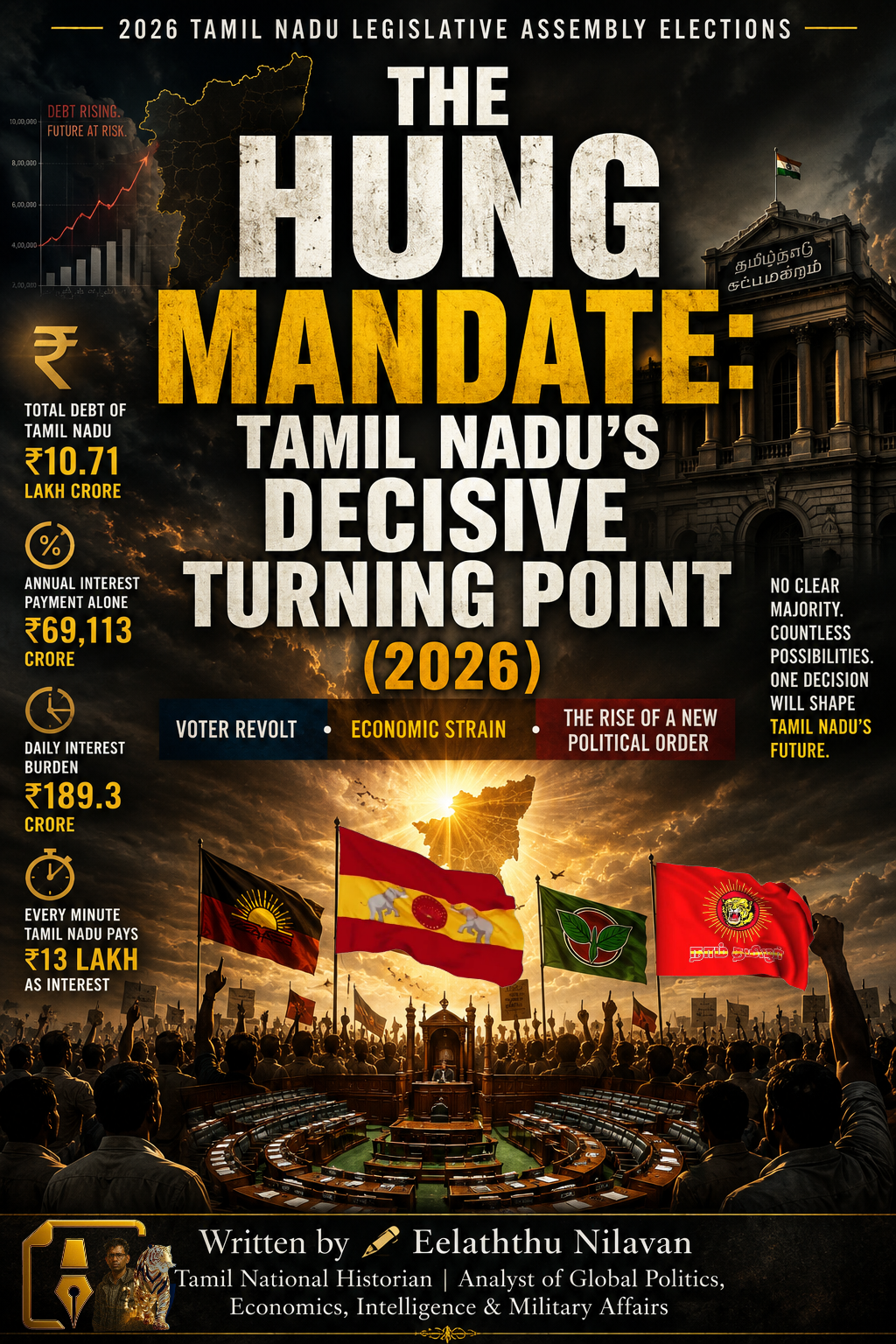
The 2026 Tamil Nadu Legislative Assembly election has produced an unprecedented political outcome—a hung assembly that has fundamentally altered the state’s political trajectory. In a 234-member house requiring 118 seats for a majority, no single party was able to cross the threshold. The Tamizhaga Vettri Kazhagam (TVK) emerged as the single largest party with 108 seats, followed by the DMK with 59 and the AIADMK with 47. Smaller parties collectively hold the balance of power, transforming them into decisive “kingmakers.”
This fractured mandate reflects not just a political shift but a deeper churn in voter psychology. The electorate has decisively moved away from clear majorities, signalling both dissatisfaction with traditional power structures and uncertainty about emerging alternatives. The result is a system where governance will depend not on dominance, but on negotiation, compromise, and fragile alliances.
THE “VIJAY FACTOR”: A NEW FORCE IN MASS POLITICS
A defining feature of this election has been the dramatic rise of TVK, driven largely by the mass appeal of its leader. Voters, especially younger demographics and urban populations, were drawn to the idea of a “fresh alternative” to the entrenched Dravidian parties. The sweeping victory in Chennai—where TVK secured 14 out of 16 seats—illustrates a powerful urban shift.
However, this support is not without scepticism. For some voters, the appeal lies in hope and novelty; for others, it raises questions about whether cinematic charisma can translate into administrative competence. This duality—hope versus caution—captures the essence of the current political mood.
“SEEMAN DIDN’T LOSE, THE PEOPLE LOST”: A POLARIZED PUBLIC REACTION
Despite another electoral defeat, Seeman and his Naam Tamilar Katchi (NTK) continue to command a loyal and emotionally driven support base. Among his followers, the narrative is not one of failure, but of missed opportunity—arguing that voters have once again prioritised short-term incentives over long-term structural change.
Supporters emphasise Seeman’s ideological consistency, particularly his focus on Tamil nationalism, environmental protection, and systemic reforms like free education and healthcare. His persistence in contesting all 234 seats is seen as a testament to resilience, though critics point out that his message has yet to penetrate beyond educated or niche segments of society.
This divide highlights a crucial reality: while ideological politics has depth, mass politics often depends on reach, relatability, and immediate appeal.
ECONOMIC REALITIES: AN UNSUSTAINABLE FISCAL PATH
Beyond political narratives, a more urgent concern looms over Tamil Nadu: its financial condition. With a total debt of ₹10.71 lakh crore and annual interest payments exceeding ₹69,000 crore, the state faces a mounting fiscal crisis.
The scale is staggering—₹189 crore paid daily just in interest. This translates to approximately ₹13 lakh every minute, a figure that starkly illustrates the cost of sustained borrowing. Such a financial burden severely limits the government’s ability to invest in long-term development.
This raises fundamental questions about governance priorities. Public sentiment increasingly reflects concern over rising living costs, high education fees, and inflation. Many voters express a preference for systemic economic improvements—such as lowering essential costs—over direct “freebie” distributions that may exacerbate fiscal strain.
GOVERNANCE IN UNCERTAINTY: THE FRAGILE PATH AHEAD
In the absence of a clear majority, the process of government formation becomes constitutionally structured but politically complex. The Governor is expected to invite the single largest party to form the government, subject to a floor test in the Assembly.
However, such a government would inherently depend on external support, making it vulnerable to instability. Coalition dynamics often involve power-sharing arrangements, policy compromises, and constant negotiation. Even minor disagreements can trigger withdrawals of support, leading to potential government collapse.
The risk of “horse-trading” and political manoeuvring also increases in such scenarios, raising concerns about transparency and democratic integrity.
POLITICAL REALIGNMENT: THE SEARCH FOR A THIRD ALTERNATIVE
One of the most significant takeaways from this election is the electorate’s desire for a viable third alternative. For decades, Tamil Nadu politics has been dominated by two major parties. This election disrupts that binary, but does not yet resolve it.
The emerging question is not whether a third force is needed, but what form it should take. Should it be rooted in ideological clarity and long-term vision, as represented by NTK? Or should it prioritise mass appeal and immediate relatability, as seen with TVK?
The answer remains uncertain, reflecting a broader transition phase in the state’s political evolution.
A CRITICAL MOMENT: BETWEEN POPULISM AND SUSTAINABILITY
Tamil Nadu now stands at a critical juncture. The intersection of political fragmentation and economic strain creates both risk and opportunity. The choices made in this phase—by leaders and voters alike—will shape the state’s trajectory for years to come.
The debate between “freebies” and sustainable economic policy is no longer abstract; it is central to governance. Similarly, the tension between charisma-driven politics and ideology-driven politics will continue to define electoral outcomes.
CONCLUSION: A STATE IN TRANSITION
The 2026 election is not just a political event—it is a signal of transformation. It reflects a society grappling with competing aspirations: stability versus change, welfare versus sustainability, and personality versus principle.
The road ahead is uncertain, marked by fragile alliances and economic pressures. Yet, it also offers a rare opportunity—to redefine governance, reimagine political alternatives, and address structural challenges with clarity and purpose.
In this moment of flux, one truth stands out: the future of Tamil Nadu will depend not only on who governs, but on how governance itself evolves.
𝐖𝐫𝐢𝐭𝐭𝐞𝐧 𝐛𝐲:


𝐄𝐞𝐥𝐚𝐭𝐡𝐭𝐡𝐮 𝐍𝐢𝐥𝐚𝐯𝐚𝐧
Tamil National Historian | Analyst of Global Politics, Economics, Intelligence & Military Affairs
06/05/2026
The views expressed in this article are the author’s own and do not necessarily reflect Amizhthu’s editorial stance.