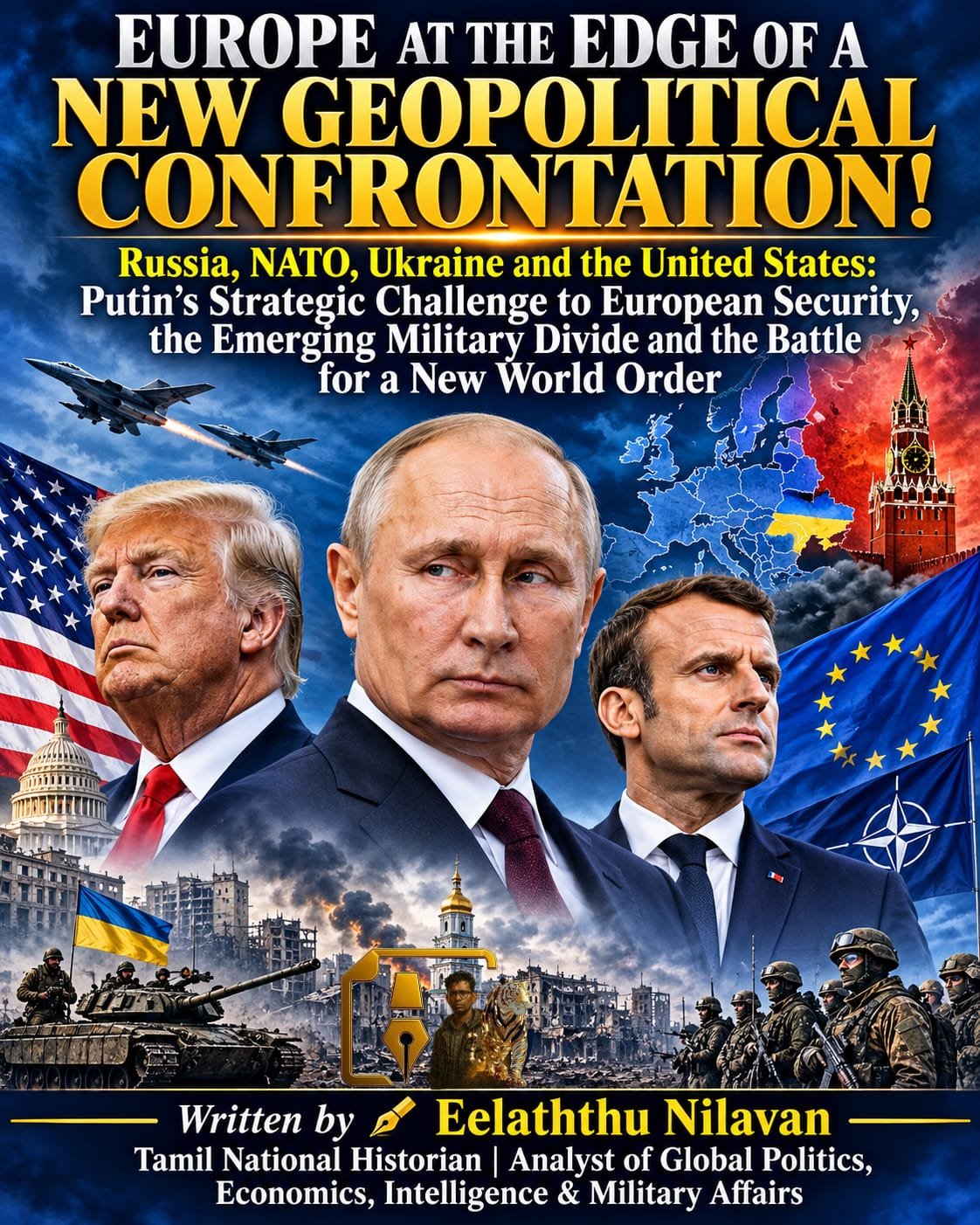

Russia, NATO, Ukraine and the United States: Putin’s Strategic Challenge to European Security, the Emerging Military Divide and the Battle for a New World Order
Written by ✒️ Eelaththu Nilavan
Tamil National Historian | Analyst of Global Politics, Economics, Intelligence & Military Affairs
A NEW AND DANGEROUS PHASE IN THE RUSSIA–UKRAINE WAR
The Russia–Ukraine war is entering another critical phase, with developments increasingly extending beyond the battlefield into international diplomacy, military alliances, economic warfare, intelligence operations and the future security architecture of Europe.
As of 12 November 2026, the international situation reveals a growing strategic confrontation involving Russia, Ukraine, the United States, NATO and the European Union.
The central question is no longer simply whether Russia and Ukraine can reach a ceasefire. It is whether the United States and Europe can agree on a common political and military framework capable of delivering a sustainable peace without creating another major confrontation with Moscow.
Recent diplomatic developments demonstrate that Washington is attempting to revive negotiations, while Moscow continues to insist that any settlement must address Russia’s broader security demands. European governments, meanwhile, are increasingly concerned that decisions about their continent’s security could be negotiated without their full participation.
This situation represents a significant test of Western unity and the international balance of power.
PUTIN’S WARNING: EUROPEAN TROOPS IN UKRAINE WOULD BECOME RUSSIAN TARGETS
One of the most consequential developments came from Russian President Vladimir Putin during his meeting with US special representatives Steve Witkoff and Jared Kushner at the Kremlin on 12 November.
Putin reiterated Moscow’s opposition to the deployment of European military personnel on Ukrainian territory following a potential peace agreement.
His message was unmistakable: Russia would consider foreign military forces deployed in Ukraine legitimate military targets.
This position directly challenges proposals from Britain, France and other European governments concerning multinational security arrangements intended to protect Ukraine after a ceasefire.
From Moscow’s perspective, the presence of European troops would represent the continuation of Western military involvement under a different arrangement.
However, from the European and Ukrainian perspective, security guarantees are essential because a ceasefire without credible protection could allow Russia to rebuild its military capabilities and potentially resume hostilities.
The disagreement exposes one of the fundamental contradictions in the peace negotiations.
Russia wants restrictions on Ukraine’s future military and strategic relationships, while Ukraine and its European partners want guarantees that prevent another Russian invasion.
Putin also criticised European governments for supporting continued military assistance to Ukraine while publicly advocating peace.
Nevertheless, the Russian president indicated that Moscow remained prepared for diplomatic engagement with European countries.
The contradiction between diplomatic openness and military threats illustrates the difficult political environment in which negotiations are taking place.
WASHINGTON’S DIPLOMATIC INITIATIVE: WITKOFF, KUSHNER AND THE MOSCOW MEETING
The participation of Steve Witkoff and Jared Kushner demonstrates the Trump administration’s determination to pursue a diplomatic settlement.
Their November 10–11 negotiations in Abu Dhabi involved Russian, Ukrainian and American representatives. Although the discussions did not produce a comprehensive peace agreement, they reportedly achieved progress towards a substantial prisoner-of-war exchange.
The American representatives subsequently travelled to Moscow to brief Putin and explore the possibility of advancing negotiations.
One particularly important development emerged from Witkoff’s subsequent remarks: he indicated that European representatives could participate in another round of negotiations.
This would represent a potentially significant diplomatic development because Moscow had previously resisted direct European involvement.
However, the Kremlin continued to express reservations about Europe’s military and political position.
The negotiations remain complicated by several unresolved issues:
- The future status of occupied Ukrainian territories.
- Ukraine’s sovereignty and territorial integrity.
- Security guarantees for Ukraine.
- The possibility of European peacekeeping or multinational forces.
- NATO’s future military presence in Eastern Europe.
- The lifting or modification of international sanctions against Russia.
- The reconstruction of Ukraine and the question of responsibility for the war’s destruction.
The central challenge for Washington is to persuade both Moscow and Kyiv that a negotiated settlement would offer greater security than continued military confrontation.
Yet a diplomatic agreement cannot become sustainable simply because Washington, Moscow and European capitals reach a political understanding. Ukraine itself must have a meaningful role in determining its future.
MACRON’S DECLARATION: EUROPE CAN NO LONGER DEPEND ON AMERICAN SUPPORT
French President Emmanuel Macron delivered one of the most politically significant messages at the European Political Community summit in Dublin on 12 November.
He declared that there was no more American support for Ukraine and argued that European countries must assume responsibility for the continent’s future security.
His statement reflects growing European concerns about Washington’s changing approach to the war.
Although the United States continues to participate in diplomatic mediation, Macron’s comments underline the European perception that Washington can no longer be regarded as the unquestioned guarantor of Ukraine’s military and financial support.
Macron emphasised that European countries and their partners, including Canada, Australia and Japan, were carrying the burden of supporting Ukraine through the Coalition of the Willing.
He also called for a united European position in future negotiations with Russia.
The ninth European Political Community summit brought together leaders from 48 invited countries, making it an important diplomatic gathering at a particularly sensitive moment.
The political significance of Macron’s intervention extends beyond Ukraine.
For decades, European security has depended heavily on American military capabilities, NATO’s collective defence arrangements and the strategic relationship between Washington and European capitals.
If European governments increasingly believe that American commitments are becoming uncertain, they will have stronger incentives to develop independent military capabilities, defence industries and diplomatic arrangements.
This could gradually reshape the relationship between the United States and Europe.
However, European strategic independence would require considerably greater defence investment, industrial capacity, political coordination and military cooperation.
THE EUROPEAN UNION’S NEW SANCTIONS: TARGETING RUSSIA’S FINANCIAL AND MILITARY NETWORKS
While diplomatic discussions continue, the European Union is preparing another significant economic pressure campaign against Russia.
On 11 November, EU ambassadors reached a preliminary agreement to impose additional sanctions on 145 individuals and entities connected to Russia.
The proposed measures include:
- 50 Russian banks.
- Energy companies and financial networks.
- Organisations facilitating Russia’s shadow fleet.
- Individuals and entities accused of supporting foreign information manipulation.
- Networks associated with hybrid activities.
- One additional designation under the EU’s cyber sanctions framework.
The proposed designations are distributed across three sanctions frameworks, with 113 listings under the main Russia sanctions regime, 31 under the hybrid activities regime and one under the cyber framework.
EU foreign ministers are expected to formally approve the measures on 16 November.
The economic objective is to restrict Russia’s access to financial networks, reduce the revenue generated through oil exports and make it increasingly difficult for Moscow to finance its military operations.
The targeting of the shadow fleet is particularly important.
Russia has increasingly relied on networks of tankers, intermediaries and shipping arrangements to maintain international oil exports despite Western restrictions.
Restricting these networks could increase the cost and complexity of Russian energy exports.
However, sanctions are not an immediate mechanism for ending a war. Their effectiveness depends on enforcement, international cooperation, the availability of alternative markets and Russia’s ability to adapt its economic structures.
RUSSIA’S RESPONSE: INTELLIGENCE OPERATIONS, SABOTAGE ALLEGATIONS AND INTERNAL SECURITY
Another important development concerns Russia’s Federal Security Service (FSB).
On 12 November, the FSB announced that it had detained four suspected Ukrainian intelligence agents in three Russian regions, including a foreign national.
According to Russian authorities, the suspects were gathering intelligence on Russian military personnel, defence industrial facilities and energy infrastructure.
The FSB alleged that the network used Telegram to coordinate activities and offered financial rewards and relocation to the European Union to individuals recruited for intelligence operations.
Russian authorities also claimed that a homemade explosive device and a hand grenade had been seized from one suspect in Donetsk.
Criminal proceedings have reportedly been initiated, with the suspects potentially facing life imprisonment if convicted.
These allegations must be distinguished from independently established facts. The available reporting does not independently establish the full extent of the alleged intelligence network or the involvement of Ukrainian intelligence.
Nevertheless, the announcement illustrates the increasing importance of intelligence, counterintelligence, infrastructure protection and internal security during the war.
Modern conflicts are no longer restricted to conventional military operations.
Railways, electricity networks, energy infrastructure, telecommunications, defence factories and logistics systems have become strategically important targets.
The growing importance of these areas creates additional security challenges for both Russia and European countries.
RUSSIA’S BIOLOGICAL SECURITY CLAIMS: THE NATO LABORATORY CONTROVERSY
At a meeting of the Collective Security Treaty Organisation (CSTO) in Moscow, Russia’s consumer health watchdog chief Anna Popova made serious allegations concerning biological research facilities supported by NATO member states.
She claimed that more than 400 laboratories were involved in programmes concerning dangerous microorganisms, including facilities in Eurasia that allegedly operated beyond the effective control of their host governments.
According to Popova, these facilities collected biological samples, studied infectious diseases and investigated human susceptibility to infections.
Russia also accused Western countries of attempting to involve CSTO member states in biological programmes that could undermine regional security.
These allegations have long formed part of Russia’s broader criticism of Western-supported biological research activities.
However, claims that these laboratories are involved in offensive biological weapons programmes have not been independently established by the information presented here.
It is important to distinguish legitimate public-health research, disease surveillance and international laboratory cooperation from allegations of biological weapons development.
The CSTO discussions nevertheless demonstrate that biological security has become another area of geopolitical competition.
Putin called for stronger information-sharing and practical cooperation between CSTO members and proposed an agreement on biological safety. Kazakhstan’s President Kassym-Jomart Tokayev supported the proposal.
The issue illustrates how Russia is attempting to strengthen security cooperation with its regional partners beyond conventional military arrangements.
THE BALTIC STATES: NATO’S AIR DEFENCE CAPABILITIES UNDER PRESSURE
The unidentified drone incident over the Baltic region represents another worrying development.
During the night of 10–11 November, several aerial objects were reported moving through Belarusian, Lithuanian, Latvian and Estonian airspace.
One drone entered Lithuania from Belarus, briefly crossed into Polish airspace and subsequently returned to Lithuania.
NATO fighter aircraft attempted twice to intercept it, but both attempts failed. A missile missed its target and fell to the ground.
The drone subsequently travelled through Latvia and Estonia before reportedly reaching Russian territory.
Its precise origin, type, operator and payload remained unknown.
Lithuanian military officials suggested that electronic warfare associated with Ukraine’s overnight drone operations against Russia could be one possible explanation.
The incident raises important questions about NATO’s ability to identify and respond to unidentified aerial threats across its eastern borders.
The Baltic region occupies a strategically sensitive position between NATO territory, Belarus and Russia.
Lithuania, Latvia and Estonia are particularly exposed because of their geographical proximity to Russian military positions and Belarus, which maintains a close military relationship with Moscow.
An unidentified drone crossing several NATO countries does not automatically constitute a deliberate Russian or Belarusian attack.
However, repeated airspace incidents increase the risk of miscalculation, particularly when military aircraft are attempting interceptions under uncertain conditions.
The incident demonstrates why air surveillance, electronic warfare capabilities, integrated radar networks and rapid communication between NATO members are increasingly important.
THE BRITISH–RUSSIAN MILITARY COMMUNICATION CHANNEL: A SMALL DIPLOMATIC OPENING?
An interesting development has emerged in relations between London and Moscow.
British Defence Secretary Wes Streeting has called for additional communication channels with Russia, particularly direct military-to-military contact, to reduce the danger of military miscalculation.
Russia’s Foreign Ministry spokesperson Maria Zakharova responded by saying that Britain’s Defence Secretary could contact the Russian Defence Ministry and that Moscow would be prepared to answer.
The disagreement reflects the deterioration of relations following Russia’s invasion of Ukraine and Britain’s strong military, political and economic support for Kyiv.
Moscow has accused London of closing communication channels following the expulsion of a Russian military attaché in 2024.
Britain, however, said the individual was an undeclared military intelligence officer.
Despite these disagreements, the possibility of renewed military communication is strategically significant.
Britain is a leading NATO military power and possesses nuclear weapons. Russia is also a major nuclear power.
When two nuclear-armed countries maintain limited direct military communication during an active international confrontation, the danger of misunderstanding becomes a serious security concern.
Communication does not mean political reconciliation or an end to military competition.
It is a mechanism for preventing an incident from developing into a much larger confrontation.
MOSCOW REJECTS EUROPEAN PEACEKEEPING: THE BRITISH AND FRENCH MILITARY QUESTION
Russia has also rejected European proposals for a multinational military presence in Ukraine after a possible peace agreement.
Maria Zakharova criticised British and French military exercises designed to rehearse the potential deployment of multinational forces.
Moscow argues that such arrangements would increase European involvement in the conflict rather than establish lasting peace.
European governments, however, regard security guarantees as an essential part of any agreement.
This creates a fundamental disagreement.
For Ukraine, a peace agreement without enforceable security arrangements could leave the country vulnerable to another invasion.
For Russia, European military personnel stationed in Ukraine would represent a strategic threat close to its borders.
The problem is therefore not simply the presence or absence of peacekeeping forces.
It concerns the future military balance between Russia, Ukraine and NATO.
Any settlement that ignores these competing security concerns risks becoming a temporary pause rather than a durable political solution.
THE KYIV MISSILE ATTACK: DIPLOMACY CONTINUES WHILE THE WAR INTENSIFIES
One of the clearest demonstrations of the contradiction between diplomacy and military escalation came on 12 November.
Russian forces launched another large-scale overnight missile and drone attack against Kyiv and other Ukrainian locations.
According to Ukrainian reporting, the assault involved Iskander-M and S-400 ballistic missiles, Zircon missiles and more than 120 long-range attack drones.
Ukrainian authorities reported casualties, damage to residential buildings and disruption to infrastructure.
The attacks followed the Abu Dhabi negotiations, which had concluded without a comprehensive breakthrough.
The timing is politically significant.
While American representatives were travelling to Moscow to discuss diplomatic pathways, Russian missiles and drones continued to strike Ukrainian territory.
The attacks reinforce Ukraine’s argument that any ceasefire must be accompanied by credible security guarantees.
They also demonstrate that diplomatic negotiations are taking place alongside continued military pressure.
The war is therefore developing on two interconnected fronts: the battlefield and the negotiating table.
Neither side appears prepared to abandon its fundamental strategic objectives.
NATO’S WARNING: RUSSIA REMAINS A LONG-TERM SECURITY THREAT
NATO Secretary-General Mark Rutte has continued to warn that Russia represents a long-term threat to the alliance.
He has urged NATO members to increase defence spending, expand military production and maintain support for Ukraine.
Rutte also referred to preliminary estimates suggesting that Russian military casualties, including personnel killed and seriously wounded, may have exceeded 50,000 during October.
These figures are NATO’s assessment and should not be treated as independently verified casualty totals.
Nevertheless, they illustrate the enormous human cost of the war.
Rutte has also accused Russia of attempting to destabilise European societies through cyberattacks, sabotage, arson and other hostile activities.
Russia denies accusations of conducting a broader campaign of hybrid attacks against NATO countries.
The wider issue is that NATO is increasingly treating the Russian threat as a long-term strategic challenge rather than a temporary crisis associated exclusively with Ukraine.
This explains the growing emphasis on ammunition production, air defence systems, military infrastructure, intelligence cooperation and defence preparedness.
THE UNITED STATES, EUROPE AND THE FUTURE OF THE WESTERN ALLIANCE
The growing disagreement between Washington and European capitals is one of the most important political consequences of the war.
The United States remains central to the diplomatic process, but European leaders increasingly want a direct role in negotiations that will determine their own security.
Macron’s declaration in Dublin reflects a wider European debate about strategic autonomy.
For decades, NATO has provided the central framework for European collective defence, with the United States contributing substantial military capabilities.
However, changing American political priorities and the renewed emphasis on negotiating directly with Moscow have encouraged European governments to reconsider their dependence on Washington.
There are three major questions facing Europe:
First, can European countries develop sufficient military and industrial capacity to support Ukraine and defend themselves without depending so heavily on American assistance?
Second, can Britain, France, Germany, Poland and other European governments maintain a united position despite differences in their political and economic priorities?
Third, can Europe participate meaningfully in negotiations with Russia without accepting an agreement that undermines Ukrainian sovereignty?
These questions will influence European security for many years.
THE CSTO SUMMIT: PUTIN STRENGTHENS RUSSIA’S REGIONAL SECURITY NETWORK
While Russia is confronting NATO over Ukraine, Moscow is also strengthening its relationships with countries within the Collective Security Treaty Organisation.
The CSTO summit held at the Kremlin on 11 November brought together the leaders of Russia, Belarus, Kazakhstan, Kyrgyzstan and Tajikistan.
The organisation’s member states signed approximately two dozen joint documents, including a final declaration and a counterterrorism strategy extending to 2030.
Discussions included collective defence, regional stability, military cooperation and emerging security threats.
Tajikistan is scheduled to assume the organisation’s rotating chairmanship from Russia on 1 January 2027.
The CSTO is strategically important because it provides Moscow with a regional security framework extending across parts of Eastern Europe, Central Asia and the former Soviet sphere.
Although the organisation does not possess the same military and economic capabilities as NATO, it remains an important instrument of Russian regional influence.
Russia’s efforts to strengthen CSTO cooperation demonstrate that Moscow is not concentrating exclusively on the Ukrainian battlefield.
It is also seeking to preserve its influence among neighbouring states and maintain strategic partnerships beyond Europe.
THE BIGGER GEOPOLITICAL PICTURE: IS EUROPE MOVING TOWARDS A NEW SECURITY ORDER?
When these developments are examined together, a much larger geopolitical picture emerges.
Russia is attempting to secure its strategic objectives in Ukraine while challenging the existing European security architecture.
The United States is attempting to negotiate an end to the war while balancing its relationships with Russia, Ukraine and European allies.
European governments are trying to prevent a settlement that would leave Ukraine strategically vulnerable or exclude Europe from decisions concerning its own security.
NATO is preparing for a prolonged period of military competition with Russia.
Meanwhile, the EU is expanding economic sanctions, strengthening defence cooperation and attempting to reduce vulnerabilities in its financial and energy systems.
These developments suggest five major strategic trends.
First: The return of great-power diplomacy.
The United States and Russia are once again engaging in direct negotiations over questions that affect the wider European security environment.
Second: European strategic independence.
European governments increasingly recognise that their security cannot depend entirely on the political priorities of the White House.
Third: The expansion of hybrid warfare.
Cyber operations, intelligence networks, drones, sabotage allegations, information campaigns and attacks on critical infrastructure are becoming central elements of modern geopolitical competition.
Fourth: The militarisation of European security.
NATO countries are increasingly focusing on defence spending, military production, air defence, ammunition supplies and preparedness for prolonged confrontation.
Fifth: The struggle over the future international order.
The conflict is increasingly connected to competing visions of sovereignty, territorial security, military alliances and the distribution of global political influence.
CONCLUSION: PEACE NEGOTIATIONS OR THE BEGINNING OF A NEW EUROPEAN CONFRONTATION?
The developments of November 2026 reveal a deeply complicated international situation.
Putin’s warning against European military deployments, Macron’s declaration concerning American support, the renewed US diplomatic initiative, the EU’s sanctions campaign, NATO’s security concerns and the continued Russian attacks on Ukraine all demonstrate that the conflict has become much larger than a territorial dispute between two neighbouring countries.
It is now a defining confrontation over European security, international power and the future relationship between Russia and the Western alliance.
The possibility of another round of negotiations involving Russia, Ukraine, the United States and European representatives offers a diplomatic opening.
However, the fundamental disagreements remain unresolved.
Russia wants its strategic demands recognised. Ukraine wants its sovereignty and territorial integrity protected. Europe wants a security framework that prevents another war. The United States wants to demonstrate that diplomatic negotiations can deliver an outcome that military confrontation has failed to produce.
The greatest danger is that an agreement designed to end the war could instead create the conditions for another confrontation if the underlying security disputes remain unresolved.
Europe is therefore approaching a historic decision.
Will its leaders establish a common security strategy capable of balancing diplomacy, military deterrence and Ukrainian sovereignty?
Or will disagreements between Washington, European capitals and Moscow create an increasingly fragmented international security environment?
The answer will influence not only the future of Ukraine but also the strategic direction of Europe, NATO and the wider international system.
The Russia–Ukraine war is no longer simply a conflict over territory. It has become a defining struggle over the future of European security and the emerging global balance of power.
Written by ✒️ Eelathththu Nilavan
Tamil National Historian | Analyst of Global Politics, Economics, Intelligence & Military Affairs
13/11/2026