


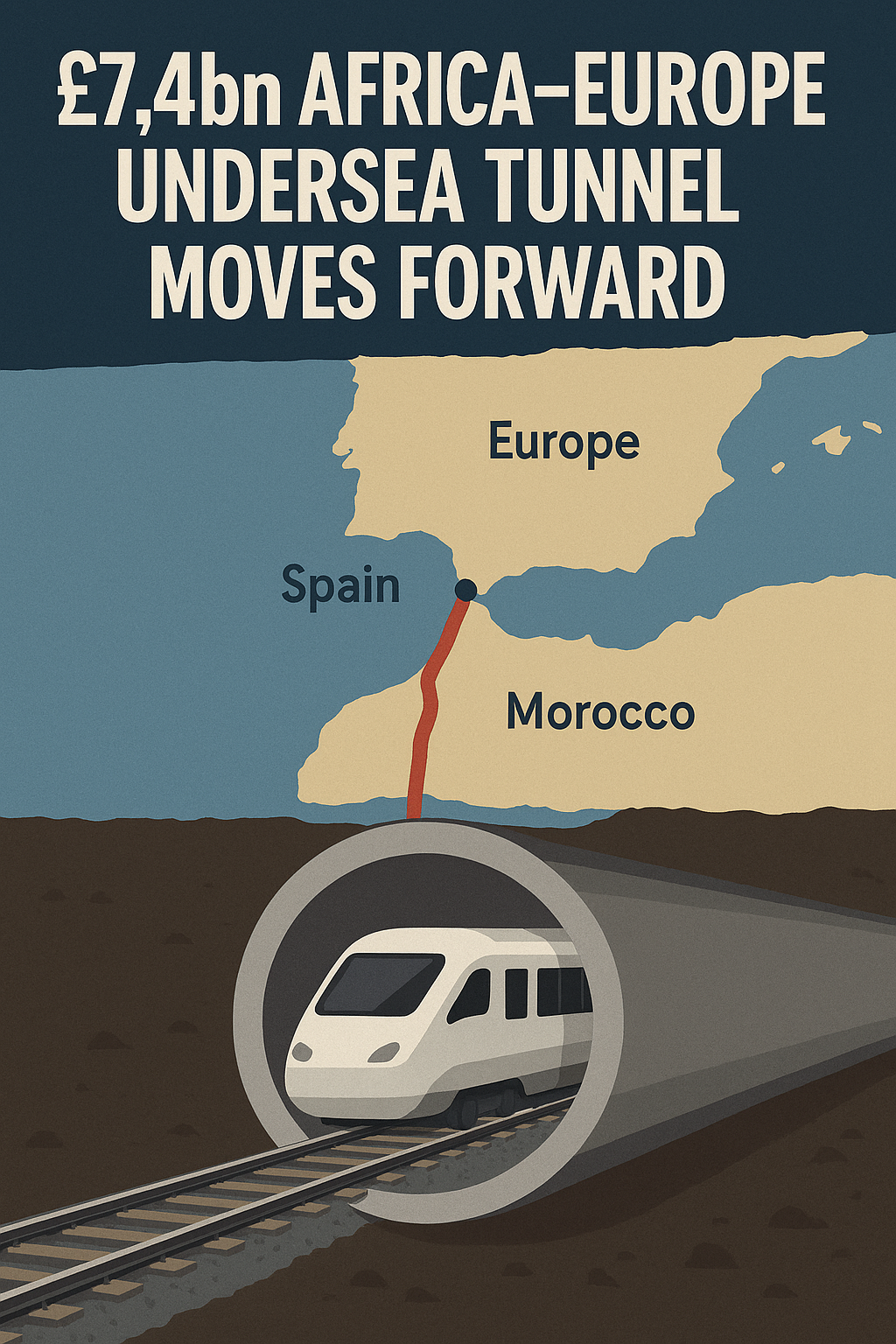
“Deep-Link Vision Gains Momentum as Spain–Morocco Tunnel Deemed Technically Feasible”
Full, Ethically Reported Summary

A long‑discussed plan to build a permanent rail tunnel beneath the Strait of Gibraltar—linking Europe and Africa for the first time—has taken a significant step forward after a new feasibility study confirmed that the proposed £7.4 billion project is “technically viable.” The findings, commissioned by the Spanish government and conducted by German tunnel‑engineering specialists Herrenknecht, indicate that current technology is capable of drilling the 26‑mile undersea passage, though major engineering challenges remain.
The proposed tunnel would run between Punta Paloma in Cádiz, Spain, and Cape Malabata near Tangier, Morocco, with nearly 17 miles of the route submerged and reaching an estimated depth of around 420 m—far deeper than the Channel Tunnel’s 74 m maximum depth. The design envisions two parallel rail tunnels carrying high‑speed passenger trains and freight, dramatically reducing travel times between Madrid and Casablanca from roughly 12 hours by car and ferry to about 5.5 hours by rail.
The study highlights complex geological conditions at the Camarinal Threshold, one of the most technically demanding sections of the Strait. Further analysis is now underway to determine how to safely construct this portion of the route.
Spain’s public engineering firm Ineco has been tasked with developing a full blueprint by 2027, after which both Spain and Morocco are expected to make a joint decision on advancing to an exploratory tunnel phase. While early hopes of completing the project by the 2030 FIFA World Cup have been dismissed as unrealistic, current projections suggest fieldwork could begin in 2030, with major construction taking place between 2035 and 2040.
If approved, the tunnel would become one of the world’s longest and deepest undersea rail links, with the potential to reshape trade, tourism, and economic integration between Europe and Africa. Supporters argue it could create a faster, more efficient freight corridor and strengthen diplomatic and commercial ties across the Mediterranean. However, the project still faces significant financial, environmental, and technical hurdles before construction can begin.
