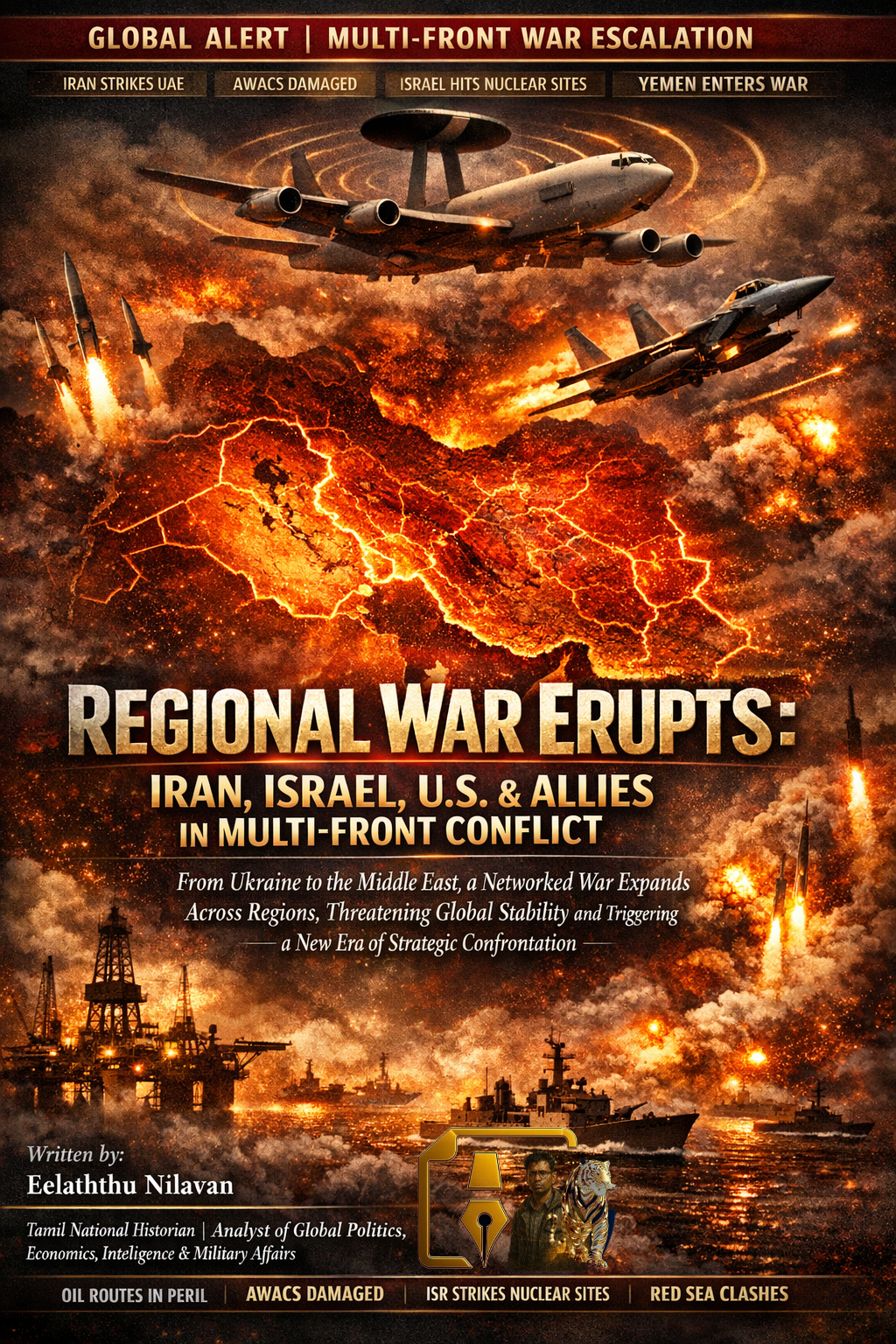

A Global Conflict No Longer Contained
The geopolitical landscape has entered a dangerous new phase as multiple flashpoints across the Middle East and beyond begin to merge into what analysts increasingly describe as a proto-regional war with global implications. What began as isolated confrontations tied to the Ukraine war and Iran–Israel tensions has now expanded into a multi-theatre conflict involving state and non-state actors, advanced weaponry, and strategic infrastructure.
From the Gulf to the Levant and the Red Sea, the pace, scale, and coordination of military actions suggest that the conflict is no longer confined—it is spreading, synchronizing, and intensifying.
IRAN STRIKES UAE: A DIRECT MESSAGE TO UKRAINE AND THE U.S.
Dubai Attack Signals Strategic Expansion
Iran’s reported strike on a Ukrainian-linked anti-drone depot in Dubai marks a historic escalation, bringing the Ukraine war into the Middle East in a direct and kinetic way.
Tehran claims the facility was:
• A logistical hub for U.S. military operations
• A storage site for advanced Ukrainian anti-drone systems
• Part of a broader Western-backed surveillance and defense network
Casualties and Strategic Shockwaves
• Reports suggest up to 30 Ukrainian personnel missing
• Potential fatalities could trigger direct diplomatic or military retaliation
• The strike coincides with high-level Ukrainian diplomatic engagement in the Gulf
Implication
Iran has effectively declared that any Ukrainian military footprint in the Middle East is now a legitimate target, dramatically widening the war’s scope.
“EYES IN THE SKY” HIT: U.S. AWACS DAMAGED IN SAUDI ARABIA
Precision Strike on High-Value Asset
A coordinated Iranian missile and drone assault targeted a key U.S. military installation, damaging a Boeing E-3 Sentry (AWACS) aircraft—one of the most critical assets in modern aerial warfare.
Why This Matters
• AWACS aircraft are essential for:
• Airspace control
• Real-time battlefield coordination
• Missile defense integration
• Damaging one represents a major intelligence and operational setback
Exposure of Defense Gaps
The attack revealed:
• Vulnerabilities in Gulf air defense systems
• The growing effectiveness of Iran’s long-range precision strike capabilities
U.S. Response
• Deployment of additional forces, including amphibious units
• Reinforcement of regional air defense coordination
• Increased readiness across key bases
ISRAEL STRIKES IRAN: NUCLEAR AND INDUSTRIAL TARGETS HIT
Deep-Strike Operations Expand War Scope
Israel has launched one of its most extensive strike campaigns against Iran, targeting:
• Uranium processing facilities
• Heavy water reactor infrastructure
• Missile and weapons development sites
• Strategic industrial sectors, including steel production
Strategic Objectives
• Cripple Iran’s nuclear development capability
• Disrupt military-industrial production chains
• Undermine economic resilience
Iran’s Response
Iran has signaled:
• Imminent multi-domain retaliation
• Potential targeting of Israeli and allied assets globally
YEMEN ENTERS THE WAR: A NEW FRONT OPENS
Ballistic Missile Launch Toward Israel
A missile launched from Yemen toward southern Israel marks a geographic and strategic turning point.
Key Developments
• Interception prevented casualties
• Demonstrates long-range strike capability from Yemen
• Signals coordination with broader anti-Israel/Iran-aligned networks
Strategic Impact
• The conflict is now multi-front:
• Northern front (Lebanon)
• Eastern front (Iran)
• Southern front (Yemen)
HEZBOLLAH ESCALATES: ISRAEL–LEBANON FRONT IGNITES
Coordinated Drone and Rocket Assaults
Hezbollah has intensified operations with:
• Drone strikes on Israeli bases
• Rocket barrages targeting military infrastructure
• Ambushes on troop positions
Battlefield Evolution
• Increased use of combined arms tactics
• Expansion of cross-border engagement zones
RUSSIA’S POSITION: STRATEGIC SIGNALING AND WARNING
Military-Technical Cooperation with Iran
Russia confirms:
• Ongoing defense cooperation with Iran
• Supply of certain military technologies
However, it denies providing targeting intelligence, asserting that U.S. base locations are publicly known.
Warning of Global Consequences
Russia has raised alarms over:
• Risks of radioactive contamination from nuclear site strikes
• Potential collapse of global nuclear security frameworks
• Escalation toward direct great-power confrontation
A MULTI-ACTOR CONFLICT: THE NEW REALITY
Key Players Now Involved
• Iran
• Israel
• United States
• Ukraine
• Gulf States
• Yemen (Houthis)
• Hezbollah
• Russia
Nature of the Conflict
This is no longer a single պատերազմ or proxy war. It is:
• Networked warfare across regions
• Hybrid conflict combining drones, missiles, cyber, and intelligence
• Strategic deterrence breakdown
WHAT COMES NEXT: ESCALATION OR CONTAINMENT?
High-Risk Scenarios
• Direct U.S.–Iran military confrontation
• Israeli strikes triggering full Iranian retaliation
• Closure or disruption of critical energy routes
• NATO involvement under expanded security threats
Global Implications
• Energy markets destabilized
• Airspace and maritime routes at risk
• Increased probability of miscalculation leading to large-scale war
FINAL ANALYSIS: A WORLD AT THE EDGE
The current trajectory suggests that the international system is entering one of its most volatile periods in decades. The interconnection between conflicts—Ukraine, Iran-Israel, and Gulf tensions—has created a single, expanding theatre of conflict, where actions in one region rapidly trigger consequences in another.
Unless immediate diplomatic interventions succeed, the world may be witnessing the early stages of a broader global confrontation, where regional wars begin to merge into a far more dangerous and unpredictable crisis.

Written by Eelaththu Nilavan
Tamil National Historian | Analyst of Global Politics, Economics, Intelligence & Military Affairs
29/03/2026
The views expressed in this article are the author’s own and do not necessarily reflect Amizhthu’s editorial stance.