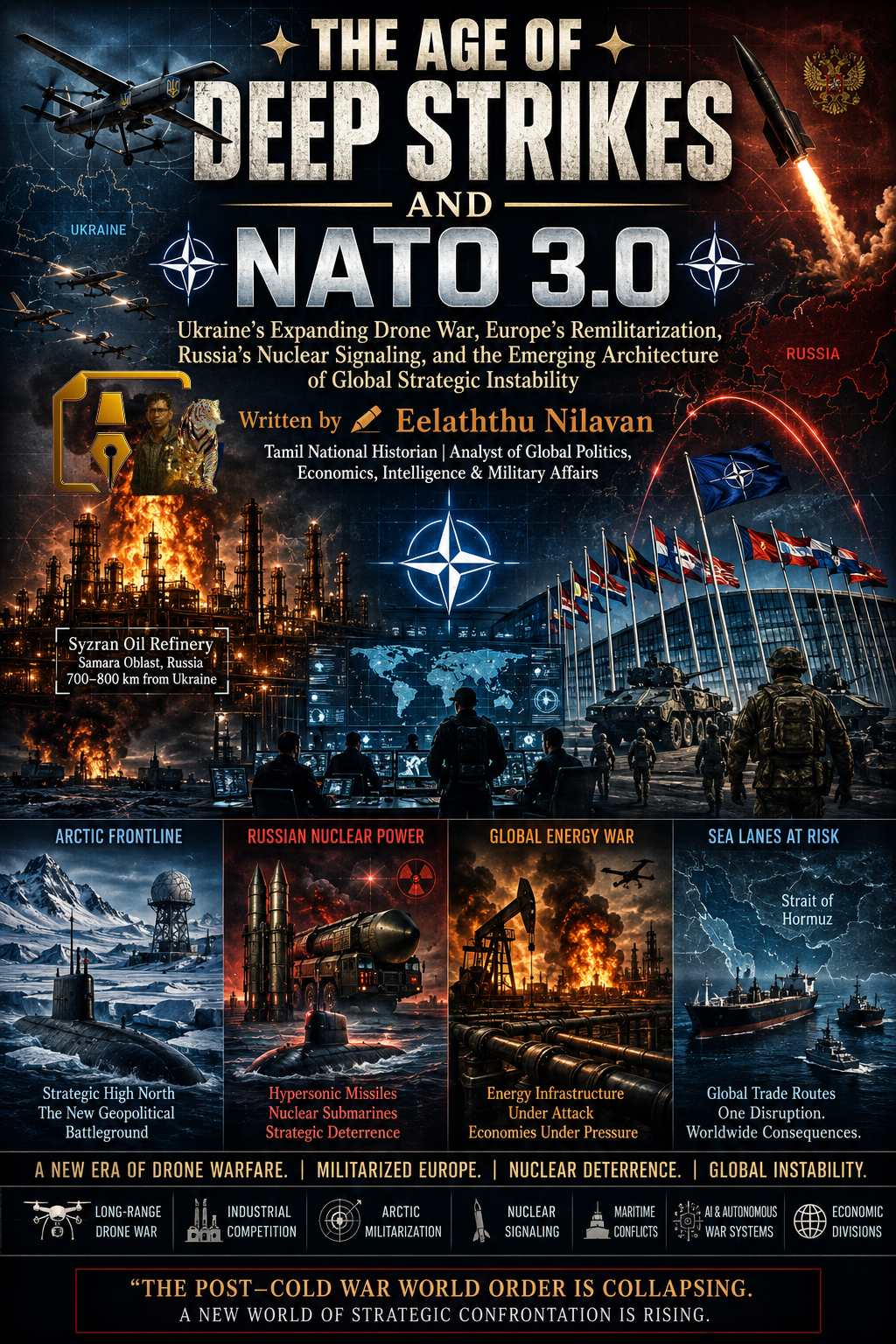

THE WAR HAS ENTERED A NEW PHASE
The war in Ukraine is no longer confined to trench lines in Donetsk, missile barrages over Kharkiv, or naval tensions in the Black Sea. A dramatic transformation is now unfolding across the wider Eurasian geopolitical theatre. The conflict has evolved into a vast strategic confrontation involving long-range drone warfare, energy infrastructure sabotage, Arctic militarisation, nuclear signalling, economic fragmentation, and the restructuring of NATO itself.
Ukraine’s recent deep-strike drone attack against the Syzran oil refinery in Russia’s Samara Oblast marks another milestone in this evolving war. Located approximately 700–800 kilometres from Ukrainian territory, the Rosneft-owned refinery represents not merely an industrial target but a strategic node within Russia’s military-energy ecosystem. The strike triggered a major fire, reportedly killed two individuals, and further exposed the vulnerability of Russia’s internal infrastructure to modern unmanned warfare.
What once appeared impossible in the early stages of the conflict has now become normalised: Ukrainian drones penetrating deep into Russian territory, striking strategic energy assets, and disrupting Moscow’s wartime logistics from within.
This is no longer simply a defensive war for Ukraine. It has become a campaign of strategic attrition against the Russian state itself.
UKRAINE’S LONG-RANGE DRONE DOCTRINE
Kyiv’s expanding drone campaign represents one of the most significant military innovations of the 21st century. Ukrainian unmanned systems forces have effectively rewritten the doctrine of asymmetric warfare by combining low-cost drone technology with long-range precision strike capabilities.
The attacks on Syzran, Ryazan, Kstovo, and facilities surrounding Moscow reveal a coordinated effort to target Russia’s refining and fuel infrastructure — the economic arteries sustaining the Kremlin’s military machine.
These attacks serve several objectives simultaneously:
• reducing Russia’s fuel production capacity,
• increasing domestic economic pressure,
• forcing Moscow to divert air defence systems inward,
• exposing vulnerabilities in Russian territorial defence,
• and psychologically undermining the perception of Kremlin invulnerability.
President Volodymyr Zelensky’s description of these operations as “long-range sanctions” is strategically revealing. Ukraine increasingly views drone warfare not merely as battlefield support, but as an instrument of economic warfare comparable to Western sanctions regimes.
This doctrine is transforming the nature of modern conflict.
Unlike traditional missile campaigns requiring expensive strategic bombers or naval platforms, Ukraine has demonstrated that relatively inexpensive unmanned systems can penetrate hundreds of kilometres into hostile territory and inflict disproportionate economic damage.
The implications extend far beyond Eastern Europe.
Military planners across NATO, China, India, Iran, Israel, and the Indo-Pacific are studying Ukraine’s drone operations closely. The future battlefield may increasingly belong not to tanks or fighter jets alone, but to autonomous swarms, AI-assisted reconnaissance systems, and deep-strike drones capable of bypassing conventional military defences.
Ukraine has effectively become the world’s first large-scale laboratory for industrialised drone warfare.
NATO 3.0 — THE RETURN OF COLLECTIVE DEFENSE
At the NATO foreign ministers’ meetings in Helsingborg, one phrase echoed with historic significance:
“NATO 3.0”
Norwegian Foreign Minister Espen Barth Eide openly declared that NATO is now “preparing for actual war.”
This statement reflects a profound doctrinal shift within the alliance.
According to the framework articulated by European officials:
• NATO 1.0 represented the Cold War era of territorial deterrence against the Soviet Union.
• NATO 2.0 emerged after the Cold War, focusing on expeditionary operations in Afghanistan, Iraq, Libya, and counterterrorism missions abroad.
• NATO 3.0 marks the alliance’s return to existential territorial defence inside Europe itself.
The significance of this transition cannot be overstated.
For the first time since the collapse of the Soviet Union, European governments are openly discussing large-scale war preparation, strategic mobilisation, defence industrial expansion, and sustained military deterrence against a nuclear peer adversary.
Russia is no longer viewed as merely a regional challenge.
It is now treated as the defining long-term strategic threat to the transatlantic order.
EUROPE’S MILITARIZATION AND THE COLLAPSE OF THE POST-COLD WAR ILLUSION
For decades, Europe operated under the assumption that economic integration, globalisation, and diplomacy had permanently reduced the likelihood of continental war.
That illusion has now collapsed.
Latvian Foreign Minister Baiba Braže bluntly warned that Europe can no longer prioritize expansive welfare systems while neglecting military readiness.
Romania, Latvia, Estonia, Poland, Finland, and the Nordic states are now rapidly increasing defence spending, many approaching or surpassing NATO’s new unofficial benchmark of 5% of GDP.
This transformation signals the birth of a new European security identity.
European leaders increasingly understand that dependence on American military protection alone is strategically unsustainable — especially as Washington gradually pivots toward the Indo-Pacific and competition with China.
The concern is not simply Russian aggression.
The deeper fear is strategic abandonment.
As U.S. Secretary of State Marco Rubio reiterated, Washington continues reassessing troop deployments globally. European governments now recognise that future American administrations may demand even greater burden-sharing or reduce permanent deployments across Europe.
Consequently, Europe is entering the largest military rearmament cycle since World War II.
THE STRATEGIC IMPORTANCE OF THE ARCTIC
Another major geopolitical transformation is occurring quietly in the Arctic.
The emergence of the “Arctic 7” NATO framework demonstrates that the High North is becoming one of the most strategically sensitive regions on Earth.
Russia’s Kola Peninsula, bordering Norway, hosts a substantial portion of Moscow’s nuclear submarine fleet and strategic deterrent infrastructure. Norwegian officials openly warned that these submarines possess the capability to threaten virtually all major American cities.
This is why NATO views Arctic security not as a peripheral issue, but as central to transatlantic survival.
Climate change is intensifying the competition further.
Melting Arctic ice is opening new maritime routes, resource zones, military corridors, and submarine operating areas. Control over these northern approaches increasingly intersects with global trade, energy extraction, and nuclear deterrence strategy.
The Arctic is rapidly transforming into a militarised geopolitical frontier.
RUSSIA’S NUCLEAR SIGNALING AND THE POLITICS OF FEAR
Simultaneously, Moscow continues deploying strategic nuclear messaging as part of its broader psychological warfare doctrine.
Russian President Vladimir Putin and Belarusian leader Alexander Lukashenko recently supervised joint strategic exercises involving ballistic missiles, hypersonic systems, and cruise missile launches.
These drills are designed to communicate several messages simultaneously:
• Russia remains a nuclear superpower despite sanctions,
• Moscow retains escalation dominance,
• Belarus is increasingly integrated into Russia’s nuclear posture,
• and NATO intervention carries catastrophic risks.
This nuclear signalling is aimed not only at military planners but also at Western public opinion.
The Kremlin understands that fear of escalation remains one of its most powerful strategic weapons.
THE GLOBAL DEFENSE INDUSTRIAL CRISIS
One of the most alarming themes emerging from NATO discussions is the recognition that Western defence industries are currently incapable of sustaining prolonged industrial warfare at the necessary scale.
European officials repeatedly warned that simply increasing defence budgets will not automatically produce military strength.
Factories, supply chains, munitions production lines, rare earth dependencies, skilled labour, and strategic manufacturing capacity all require years to rebuild.
The war in Ukraine has exposed how deeply Western economies have transitioned away from wartime industrial readiness.
Modern conflicts consume artillery shells, drones, interceptors, missiles, and armoured systems at rates far exceeding current production capabilities.
This creates a dangerous strategic imbalance.
While Russia operates on a wartime industrial footing, many NATO states are still functioning within peacetime procurement structures.
The result is an urgent race to remilitarize industrial production before future escalation outpaces manufacturing capacity.
THE STRAIT OF HORMUZ AND THE EXPANDING GLOBAL CRISIS
Beyond Europe, another geopolitical flashpoint threatens global economic stability: the Strait of Hormuz.
Western governments increasingly fear that Iranian pressure tactics or maritime disruptions could destabilise the world energy market.
Romania’s announcement that it is joining Anglo-French and U.S.-led maritime initiatives to secure the Strait reflects growing concern that Middle Eastern instability could trigger simultaneous energy and shipping crises.
Nearly one-third of the global seaborne oil trade passes through Hormuz.
Any prolonged disruption would have devastating consequences for food prices, industrial supply chains, energy markets, and inflation across Europe and Asia.
Thus, NATO’s strategic calculations are no longer confined to Ukraine alone.
The alliance is increasingly preparing for a multi-theatre geopolitical environment stretching from the Arctic to the Black Sea, from Eastern Europe to the Persian Gulf.
EUROPE’S INTERNAL ENERGY DIVIDE
At the same time, Europe faces mounting internal divisions over energy policy.
Hungarian Prime Minister Péter Magyar argued that the European Union may eventually return to purchasing Russian gas after the war ends, citing geography and economic practicality.
His comments expose a growing fracture within Europe.
One bloc insists on permanent economic separation from Russia regardless of cost.
Another increasingly fears that prolonged sanctions and high energy prices are accelerating Europe’s industrial decline.
Germany’s manufacturing sector, once the engine of European economic power, has faced enormous pressure due to elevated energy costs following the reduction of Russian pipeline supplies.
This tension reveals a fundamental contradiction at the heart of Europe’s geopolitical strategy:
Can Europe simultaneously maintain economic competitiveness, strategic autonomy, green transition goals, and long-term confrontation with Russia?
That question remains unresolved.
THE NEW WORLD OF PERMANENT INSTABILITY
Taken together, these developments reveal that the international system is entering a dangerous transitional era.
The post-Cold War order, built upon globalisation, economic interdependence, and relatively stable power structures, is fragmenting.
In its place emerges a far more unstable environment characterised by:
• drone warfare,
• energy weaponisation,
• Arctic militarisation,
• defence-industrial competition,
• maritime chokepoint conflicts,
• AI-enabled military systems,
• economic fragmentation,
• and renewed nuclear deterrence politics.
Ukraine’s strike on the Syzran refinery symbolises far more than tactical battlefield adaptation.
It represents the arrival of a new strategic age.
A world in which state and non-state actors can project force deep into adversary territory using relatively inexpensive technologies.
A world in which economic infrastructure becomes frontline territory.
A world in which Europe rearms for major war while simultaneously confronting internal political and economic fractures.
And a world in which the line between regional conflict and global systemic confrontation grows thinner with each passing month.
CONCLUSION — THE DAWN OF A NEW GEOPOLITICAL ERA
The war in Ukraine is no longer simply a territorial dispute between Moscow and Kyiv.
It has become the central accelerator reshaping global military doctrine, NATO strategy, European politics, energy security, industrial policy, Arctic geopolitics, and the future architecture of international order itself.
The rise of “NATO 3.0,” the expansion of deep-strike drone warfare, and the remilitarization of Europe collectively indicate that the world is entering a prolonged era of strategic confrontation.
The geopolitical assumptions that defined the post-1991 world are fading rapidly.
What emerges next may define the balance of global power for decades to come.

𝐄𝐞𝐥𝐚𝐭𝐡𝐭𝐡𝐮 𝐍𝐢𝐥𝐚𝐯𝐚𝐧
Tamil National Historian | Analyst of Global Politics, Economics, Intelligence & Military Affairs
23/05/2026
The views expressed in this article are the author’s own and do not necessarily reflect Amizhthu’s editorial stance.