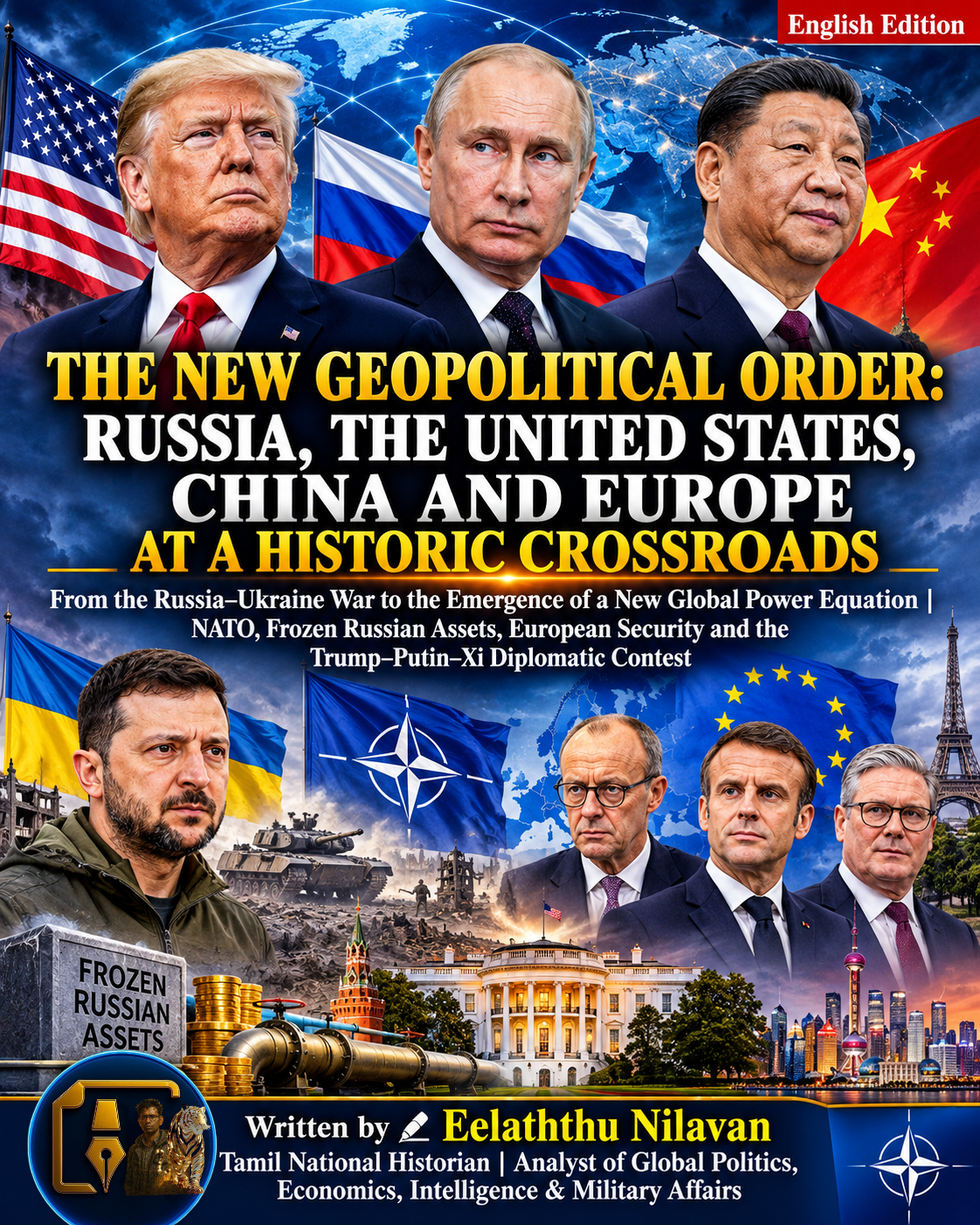

**𝐅𝐫𝐨𝐦 𝐭𝐡𝐞 𝐑𝐮𝐬𝐬𝐢𝐚–𝐔𝐤𝐫𝐚𝐢𝐧𝐞 𝐖𝐚𝐫 𝐭𝐨 𝐭𝐡𝐞 𝐄𝐦𝐞𝐫𝐠𝐞𝐧𝐜𝐞 𝐨𝐟 𝐚 𝐍𝐞𝐰 𝐆𝐥𝐨𝐛𝐚𝐥 𝐏𝐨𝐰𝐞𝐫 𝐄𝐪𝐮𝐚𝐭𝐢𝐨𝐧 | 𝐍𝐀𝐓𝐎, 𝐅𝐫𝐨𝐳𝐞𝐧 𝐑𝐮𝐬𝐬𝐢𝐚𝐧 𝐀𝐬𝐬𝐞𝐭𝐬, 𝐄𝐮𝐫𝐨𝐩𝐞𝐚𝐧 𝐒𝐞𝐜𝐮𝐫𝐢𝐭𝐲 𝐚𝐧𝐝 𝐭𝐡𝐞 𝐓𝐫𝐮𝐦𝐩–𝐏𝐮𝐭𝐢𝐧–𝐗𝐢 𝐃𝐢𝐩𝐥𝐨𝐦𝐚𝐭𝐢𝐜 𝐂𝐨𝐧𝐭𝐞𝐬𝐭
INTRODUCTION: A WORLD ENTERING A NEW GEOPOLITICAL PHASE
The international political landscape is approaching one of its most consequential turning points since the end of the Cold War. The Russia–Ukraine war, which began with Russia’s full-scale invasion in February 2022, is no longer simply a territorial confrontation between two neighbouring countries. It has evolved into a broader struggle involving international security arrangements, military alliances, economic sanctions, energy markets, nuclear deterrence and the balance of power between the world’s leading states.
Developments in November 2026 demonstrate that the diplomatic struggle is entering a particularly sensitive phase. Russia is attempting to secure strategic concessions extending far beyond the Ukrainian battlefield. The United States is pursuing negotiations involving Moscow and Kyiv, while China is increasingly positioning itself as an influential diplomatic and economic power. Meanwhile, European governments are attempting to prevent decisions about their own security from being made without their direct participation.
At the centre of this geopolitical contest are three interconnected questions: Who will determine Ukraine’s future? What will Europe’s security architecture look like? And are Washington, Moscow and Beijing moving towards a new understanding of global power?
𝐑𝐔𝐒𝐒𝐈𝐀’𝐒 𝐅𝐈𝐍𝐀𝐍𝐂𝐈𝐀𝐋 𝐂𝐎𝐔𝐍𝐓𝐄𝐑𝐎𝐅𝐅𝐄𝐍𝐒𝐈𝐕𝐄: 𝐓𝐇𝐄 𝐒𝐎𝐕𝐀 𝐂𝐀𝐏𝐈𝐓𝐀𝐋 𝐀𝐒𝐒𝐄𝐓 𝐃𝐈𝐒𝐏𝐔𝐓𝐄
Russia’s confrontation with Western governments is increasingly extending into international financial and legal institutions.
On 28 September 2026, President Vladimir Putin signed a presidential order authorising Moscow Credit Bank (MCB) to conduct transactions involving Russian securities owned by the collapsed London-based investment brokerage Sova Capital Limited.
The securities include substantial holdings in Russian strategic companies, including Rosneft, Gazprom and several electricity and infrastructure businesses.
The significance of this decision lies in the position of Sova Capital’s British administrators, Teneo Financial Advisory, who have been responsible for managing the company’s insolvency proceedings in the United Kingdom.
According to reporting on the matter, the Russian presidential order allows Moscow Credit Bank to establish, modify or terminate ownership and other rights relating to the specified securities without obtaining the administrators’ consent.
The development raises a fundamental question about the ability of British insolvency administrators to protect assets when those assets are physically located within Russian jurisdiction.
Moscow Credit Bank is itself subject to UK sanctions. Consequently, the dispute exposes a growing conflict between Russian domestic legal authority and Western financial restrictions.
The wider significance extends beyond Sova Capital. Following the invasion of Ukraine, Western governments froze approximately $300 billion in Russian sovereign assets. A substantial proportion is held through Euroclear in Belgium.
Russia has increasingly sought alternative legal and financial mechanisms to challenge the restrictions and recover access to assets held outside its immediate control.
This is becoming a separate financial battlefield in the wider geopolitical confrontation.
𝐓𝐇𝐄 𝐄𝐔𝐑𝐎𝐏𝐄𝐀𝐍 𝐒𝐀𝐍𝐂𝐓𝐈𝐎𝐍𝐒 𝐂𝐎𝐔𝐍𝐓𝐄𝐑𝐎𝐅𝐅𝐄𝐍𝐒𝐈𝐕𝐄: 𝟓𝟎 𝐑𝐔𝐒𝐒𝐈𝐀𝐍 𝐁𝐀𝐍𝐊𝐒 𝐈𝐍 𝐓𝐇𝐄 𝐍𝐄𝐖 𝐅𝐈𝐍𝐀𝐍𝐂𝐈𝐀𝐋 𝐓𝐀𝐑𝐆𝐄𝐓
While Moscow is attempting to regain access to restricted financial assets, the European Union is preparing further measures against Russia’s financial infrastructure.
On 11 November, EU representatives agreed on new sanctions listings targeting 145 individuals and entities connected to Russia’s financial networks, shadow fleet operations and alleged disinformation activities.
The proposed measures include 50 Russian banks, energy companies and organisations supporting Russia’s international financial operations.
The measures were expected to be considered by EU foreign ministers on 16 November.
The objective is to restrict Russia’s ability to move money internationally, finance military operations and circumvent existing restrictions through alternative banking and commercial networks.
However, sanctions are not without limitations. Russia has developed alternative trading relationships, expanded financial cooperation with non-Western partners and increasingly relied on different payment arrangements.
The central question is whether additional restrictions will fundamentally change Moscow’s strategic calculations or simply encourage further adaptation of its economic system.
The financial confrontation is therefore becoming a long-term contest between Western economic pressure and Russia’s capacity to develop alternative international networks.
𝐄𝐔𝐑𝐎𝐏𝐄 𝐃𝐄𝐌𝐀𝐍𝐃𝐒 𝐀 𝐒𝐄𝐀𝐓 𝐀𝐓 𝐓𝐇𝐄 𝐍𝐄𝐆𝐎𝐓𝐈𝐀𝐓𝐈𝐍𝐆 𝐓𝐀𝐁𝐋𝐄
One of the most important diplomatic developments has emerged from European leaders’ discussions in Dublin.
European governments have agreed to establish a five-power negotiating team known as the E5, comprising:
- United Kingdom
- France
- Germany
- Italy
- Poland
The five countries will work alongside the European Union’s institutions to represent European interests in future discussions concerning Ukraine.
European Council President António Costa has defended this collective arrangement, arguing that Europe must speak with a united voice.
European Commission President Ursula von der Leyen has also supported the approach.
The inclusion of Britain is particularly significant. Although the United Kingdom left the European Union, it remains one of Europe’s major military, intelligence, diplomatic and nuclear powers. Its participation reflects the reality that European security cannot be considered exclusively through the institutional boundaries of the EU.
Germany’s Chancellor Friedrich Merz has expressed concern that Washington and Moscow could reach another understanding without meaningful European involvement.
His concerns are partly rooted in the previous Alaska summit and the possibility of major strategic decisions being negotiated between the American and Russian presidents before European governments are consulted.
For Europe, the issue is not simply diplomatic representation. It is whether the continent will retain the ability to determine its own security arrangements.
𝐊𝐀𝐉𝐀 𝐊𝐀𝐋𝐋𝐀𝐒 𝐀𝐍𝐃 𝐓𝐇𝐄 𝐒𝐓𝐑𝐔𝐆𝐆𝐋𝐄 𝐎𝐕𝐄𝐑 𝐖𝐇𝐎 𝐒𝐏𝐄𝐀𝐊𝐒 𝐅𝐎𝐑 𝐄𝐔𝐑𝐎𝐏𝐄
The question of European representation has also exposed political tensions within the EU.
Foreign policy chief Kaja Kallas has defended her position that she should represent the bloc on foreign and security policy matters, pointing to the mandate agreed by member states in 2024.
Her argument is that Europe already possesses established diplomatic institutions and should use them rather than appointing representatives without a clear institutional mandate.
However, the emerging E5 arrangement suggests that European leaders favour a broader collective structure.
The disagreement is important because the negotiating process will involve much more than ending military operations in Ukraine.
It will potentially address NATO enlargement, military deployments, European defence capabilities, security guarantees and the future relationship between Russia and Western governments.
Kallas has argued that a ceasefire should precede wider negotiations over European security.
This position reflects a concern that allowing Moscow to negotiate the future of NATO before ending the war could give Russia strategic advantages without requiring corresponding concessions.
The challenge for Europe is to transform its collective economic and military strength into a coherent diplomatic strategy.
𝐑𝐔𝐒𝐒𝐈𝐀’𝐒 𝟏𝟗𝟗𝟕 𝐃𝐄𝐌𝐀𝐍𝐃: 𝐀 𝐃𝐈𝐑𝐄𝐂𝐓 𝐂𝐇𝐀𝐋𝐋𝐄𝐍𝐆𝐄 𝐓𝐎 𝐍𝐀𝐓𝐎’𝐒 𝐏𝐎𝐒𝐓-𝐂𝐎𝐋𝐃 𝐖𝐀𝐑 𝐎𝐑𝐃𝐄𝐑
Perhaps the most consequential element of the current negotiations is Russia’s reported attempt to revive its demand that NATO return to its military positions of 1997.
According to reporting by The New York Times, Russian representatives circulated an unsigned diplomatic document during the Abu Dhabi negotiations dated 10 November 2026.
The document reportedly repeats important elements of Russia’s December 2021 proposals, which were presented shortly before the full-scale invasion of Ukraine.
Moscow is seeking restrictions on NATO’s future expansion and military activities, alongside a withdrawal of NATO forces to positions that existed before the alliance’s major eastward enlargement.
Such a withdrawal would have enormous consequences for Poland, Estonia, Latvia, Lithuania and other countries that joined NATO after 1997.
It would fundamentally challenge the security arrangements established in Europe following the collapse of the Soviet Union.
From Moscow’s perspective, these demands are presented as necessary to establish a new security balance and address what Russia describes as NATO’s expansion towards its borders.
However, NATO members maintain that sovereign countries have the right to choose their own alliances.
Poland and the Baltic states would face particularly serious strategic consequences if such a proposal were ever accepted.
The demand therefore raises a question much larger than the Ukrainian territorial dispute:
Can Russia obtain through negotiations what it has been unable to achieve through military force — a fundamental restructuring of Europe’s security architecture?
𝐙𝐄𝐋𝐄𝐍𝐒𝐊𝐘’𝐒 𝐃𝐎𝐍𝐁𝐀𝐒 𝐑𝐄𝐕𝐄𝐋𝐀𝐓𝐈𝐎𝐍: 𝐓𝐄𝐑𝐑𝐈𝐓𝐎𝐑𝐘 𝐈𝐍 𝐄𝐗𝐂𝐇𝐀𝐍𝐆𝐄 𝐅𝐎𝐑 𝐍𝐀𝐓𝐎 𝐌𝐄𝐌𝐁𝐄𝐑𝐒𝐇𝐈𝐏?
A particularly significant development emerged on 14 November when Ukrainian President Volodymyr Zelensky revealed that American negotiators had raised an unprecedented question during discussions about a possible settlement.
According to Zelensky, Washington asked whether Ukraine would consider withdrawing from Donbas in exchange for NATO membership.
This is a major diplomatic development because it potentially links two issues that have remained central to the conflict: Ukrainian territorial sovereignty and future security guarantees.
Zelensky has made clear that Ukraine is not prepared simply to surrender its territory.
He has also emphasised that withdrawing Ukrainian forces from an area would not automatically mean recognising Russian sovereignty over occupied Ukrainian territory.
Importantly, Zelensky indicated that any comprehensive proposal would need to include credible NATO and European security guarantees, the right to maintain a strong and adequately funded Ukrainian military, and financial assistance for reconstruction.
He suggested that if such a package were formally established, Ukrainian society would need to have a say in accepting or rejecting it.
The political and constitutional implications are enormous.
For Ukraine, NATO membership has long been viewed as a potential long-term protection against another Russian invasion.
For Russia, Ukrainian NATO membership remains one of its principal objections.
The possibility of exchanging territorial withdrawal for NATO membership therefore creates a complicated diplomatic equation.
Would Ukraine receive a genuine security guarantee, or would it be expected to surrender strategically important territory in exchange for a commitment whose implementation could remain uncertain?
That question could determine whether the negotiations produce a sustainable peace or simply establish the conditions for another confrontation.
𝐓𝐇𝐄 𝐊𝐎𝐍𝐒𝐓𝐀𝐍𝐓𝐈𝐍𝐎𝐕𝐊𝐀 𝐇𝐔𝐌𝐀𝐍𝐈𝐓𝐀𝐑𝐈𝐀𝐍 𝐏𝐑𝐎𝐏𝐎𝐒𝐀𝐋: 𝐇𝐔𝐌𝐀𝐍𝐈𝐓𝐀𝐑𝐈𝐀𝐍 𝐌𝐈𝐒𝐒𝐈𝐎𝐍 𝐎𝐑 𝐒𝐓𝐑𝐀𝐓𝐄𝐆𝐈𝐂 𝐂𝐎𝐍𝐓𝐑𝐎𝐕𝐄𝐑𝐒𝐘?
Another important development concerns the Russian proposal for a humanitarian operation in Konstantinovka, also known as Kostiantynivka, in the Donetsk region.
Kremlin spokesperson Dmitry Peskov has claimed that between 400 and 500 civilians remain in the city.
According to Moscow, Russian specialists would require approximately five days to clear mines from access routes and establish the necessary security arrangements for an evacuation.
Putin reportedly raised the proposal during discussions with American envoys Steve Witkoff and Jared Kushner.
Russia has suggested that the operation could involve Russian and Ukrainian human rights representatives, international observers and journalists.
Moscow presents the proposal as a humanitarian initiative designed to protect civilians trapped in an active conflict zone.
However, the proposal has generated considerable controversy.
Zelensky has questioned Russia’s intentions, arguing that the proposed operation could provide Moscow with an opportunity to advance its military position and occupy additional areas.
This disagreement is particularly important because control of the city remains contested.
The number of civilians cited by Russia and the operational details of the proposed evacuation have not been independently established.
Nevertheless, the humanitarian dimension must not be overlooked.
Civilians trapped in frontline communities require food, medical treatment, safe evacuation routes and protection from military operations, regardless of which side controls the surrounding territory.
A genuinely humanitarian operation would require a verified ceasefire, independent monitoring, safe passage and guarantees that civilians could choose their destination without coercion.
𝐓𝐇𝐄 𝐋𝐀𝐓𝐕𝐈𝐀𝐍 𝐏𝐎𝐒𝐈𝐓𝐈𝐎𝐍: 𝐄𝐔𝐑𝐎𝐏𝐄 𝐌𝐔𝐒𝐓 𝐔𝐒𝐄 𝐈𝐓𝐒 𝐎𝐖𝐍 𝐏𝐎𝐖𝐄𝐑
European leaders are increasingly concerned that excessive dependence on American diplomatic initiatives could weaken Europe’s influence over its own security.
Latvian political representatives have argued that Europe possesses substantial economic and military resources and should use that strength to demand credible guarantees for Ukraine.
This argument reflects the strategic concerns of countries geographically closest to Russia.
For Latvia, Estonia, Lithuania and Poland, the outcome of the Ukrainian war is not an abstract diplomatic question.
Their geographical position makes the future of Ukraine directly relevant to their own national security.
The argument is that a peace settlement that leaves Russia with the ability to launch another military campaign could expose the entire eastern European region to further instability.
European governments must therefore consider not only how to end the present conflict but also how to prevent another one.
𝐓𝐇𝐄 𝐓𝐑𝐔𝐌𝐏–𝐏𝐔𝐓𝐈𝐍–𝐗𝐈 𝐓𝐑𝐈𝐋𝐀𝐓𝐄𝐑𝐀𝐋 𝐌𝐄𝐄𝐓𝐈𝐍𝐆: 𝐀 𝐍𝐄𝐖 𝐆𝐋𝐎𝐁𝐀𝐋 𝐏𝐎𝐖𝐄𝐑 𝐃𝐈𝐌𝐄𝐍𝐒𝐈𝐎𝐍
One of the most extraordinary developments in the current international political environment is the White House confirmation that Donald Trump, Vladimir Putin and Xi Jinping are preparing to meet on the sidelines of the 2026 APEC summit in Shenzhen, China.
The meeting, scheduled for 19 November according to the announced plans, would bring together the leaders of three of the world’s most influential nuclear and economic powers.
The diplomatic significance is considerable.
The United States remains the leading Western military power. Russia continues to possess one of the world’s largest nuclear arsenals and considerable influence over energy and international security. China has emerged as a major economic, industrial, technological and military power.
Their simultaneous participation in a trilateral summit creates an unprecedented diplomatic opportunity.
According to the White House, discussions are expected to include nuclear weapons reduction and the war involving Iran.
American officials have indicated that Washington does not expect a concrete agreement to emerge immediately.
The future of nuclear arms control is particularly important.
The New START treaty between the United States and Russia expired in February 2026, removing the principal remaining bilateral framework limiting the two countries’ strategic nuclear arsenals.
Trump has expressed interest in developing a broader nuclear arms control arrangement that includes China.
However, Beijing has historically been reluctant to participate in a framework that would treat its much smaller nuclear arsenal as equivalent to those of Washington and Moscow.
China’s nuclear capabilities are expanding, but its arsenal remains considerably smaller than those of the United States and Russia.
For Xi Jinping, the summit also offers an opportunity to demonstrate China’s growing international diplomatic influence.
For Putin, participation represents an important opportunity to demonstrate that Russia remains a major international power despite years of Western sanctions and diplomatic isolation.
For Trump, the meeting provides an opportunity to pursue nuclear diplomacy and strengthen his position as a central figure in negotiations involving the world’s leading powers.
However, one significant issue remains: Ukraine is not expected to be a central subject of the trilateral meeting, according to American officials.
This has understandably raised concerns in Kyiv and European capitals.
𝐂𝐇𝐈𝐍𝐀’𝐒 𝐒𝐓𝐑𝐀𝐓𝐄𝐆𝐈𝐂 𝐀𝐃𝐕𝐀𝐍𝐓𝐀𝐆𝐄: 𝐓𝐇𝐄 𝐑𝐈𝐒𝐄 𝐎𝐅 𝐃𝐈𝐏𝐋𝐎𝐌𝐀𝐓𝐈𝐂 𝐌𝐔𝐋𝐓𝐈𝐏𝐎𝐋𝐀𝐑𝐈𝐓𝐘
China’s role deserves particular attention.
Beijing has developed economic and diplomatic relationships across Asia, Africa, Latin America and the Middle East.
It has also maintained a strategic partnership with Russia while preserving significant economic relations with Western countries.
This position gives China diplomatic flexibility.
Unlike Russia, China is not directly involved in the Ukrainian battlefield. Unlike the United States, it does not lead NATO or the Western military alliance system.
Its international influence increasingly comes from trade, investment, manufacturing, technology, infrastructure and diplomatic engagement.
A trilateral meeting between Trump, Putin and Xi would therefore offer China an opportunity to demonstrate that major international questions cannot necessarily be resolved through Washington and its traditional Western partners alone.
Nevertheless, it would be premature to conclude that the three countries are forming a unified geopolitical alliance.
Their strategic interests remain different.
Washington wants to maintain its global leadership. Beijing seeks to strengthen its international influence while protecting its economic and security interests. Moscow wants sanctions relief, recognition of its strategic demands and a settlement that preserves its position in the international system.
Cooperation between these powers does not automatically mean agreement.
𝐓𝐇𝐄 𝐒𝐓𝐑𝐀𝐓𝐄𝐆𝐈𝐂 𝐂𝐎𝐍𝐓𝐑𝐀𝐃𝐈𝐂𝐓𝐈𝐎𝐍: 𝐖𝐇𝐎 𝐖𝐈𝐋𝐋 𝐃𝐄𝐂𝐈𝐃𝐄 𝐔𝐊𝐑𝐀𝐈𝐍𝐄’𝐒 𝐅𝐔𝐓𝐔𝐑𝐄?
The greatest contradiction in the emerging diplomatic landscape is that Ukraine’s future could become a subject of negotiations involving major powers while Ukraine itself struggles to secure an equal position at every negotiating stage.
Kyiv wants direct participation in every decision affecting its territory, sovereignty and national security.
European governments also want meaningful involvement because the consequences of any agreement would extend across the continent.
Russia, meanwhile, wants negotiations to address not only Ukrainian territory but also NATO expansion, Western military deployments and the broader European security system.
The United States is attempting to bring the competing positions closer together.
Yet the fundamental differences remain substantial.
Russia has not abandoned its principal security demands. Ukraine has not accepted territorial surrender. European countries have not agreed to a settlement that undermines their security architecture.
The Abu Dhabi discussions have produced no comprehensive peace agreement, although an agreement in principle on a substantial prisoner exchange has offered one limited area of progress.
The rejection of an energy ceasefire, as reported by Zelensky, also demonstrates how difficult it remains to secure even limited agreements.
𝐓𝐇𝐄 𝐅𝐔𝐓𝐔𝐑𝐄 𝐎𝐅 𝐍𝐀𝐓𝐎, 𝐄𝐔𝐑𝐎𝐏𝐄𝐀𝐍 𝐃𝐄𝐅𝐄𝐍𝐂𝐄 𝐀𝐍𝐃 𝐆𝐋𝐎𝐁𝐀𝐋 𝐒𝐓𝐀𝐁𝐈𝐋𝐈𝐓𝐘
The current negotiations may ultimately determine more than the future boundaries of Ukraine.
They could influence the future structure of NATO, the military balance in Eastern Europe, the relationship between the United States and European governments, and the position of Russia in the international system.
If Russia secures restrictions on NATO’s military presence, it could achieve a significant strategic objective.
If Ukraine receives credible long-term security guarantees and maintains its sovereign independence, Kyiv could emerge from the conflict with a fundamentally different security relationship with the West.
If European governments establish a stronger common defence and diplomatic strategy, Europe could become less dependent on American political decisions.
If Washington and Beijing establish a framework for nuclear arms negotiations, it could create a new dimension of international security cooperation.
However, if negotiations fail, the consequences could be equally significant.
Continued military confrontation, further economic sanctions, increased defence spending and renewed nuclear tensions could deepen the division between the world’s major geopolitical blocs.
𝐅𝐈𝐍𝐀𝐋 𝐀𝐍𝐀𝐋𝐘𝐒𝐈𝐒: 𝐈𝐒 𝐓𝐇𝐄 𝐖𝐎𝐑𝐋𝐃 𝐌𝐎𝐕𝐈𝐍𝐆 𝐓𝐎𝐖𝐀𝐑𝐃𝐒 𝐀 𝐍𝐄𝐖 𝐆𝐋𝐎𝐁𝐀𝐋 𝐏𝐎𝐖𝐄𝐑 𝐄𝐐𝐔𝐀𝐓𝐈𝐎𝐍?
The developments of November 2026 reveal that the Russia–Ukraine war has become a central component of a much wider geopolitical transformation.
Russia is attempting to redefine the European security order and challenge the financial restrictions imposed by Western governments.
The United States is pursuing negotiations that could reshape its relationships with Moscow and Beijing.
China is positioning itself as an increasingly influential diplomatic power.
Europe is attempting to defend its strategic independence and ensure that its security is not determined exclusively through agreements between Washington and Moscow.
Ukraine remains at the centre of this struggle, but its future is increasingly connected to decisions involving the international balance of power.
The most important question is whether the emerging negotiations will produce a genuine and sustainable peace based on sovereignty, security and international law, or whether they will create another arrangement in which the interests of major powers take precedence over the rights of smaller nations.
History demonstrates that agreements made between powerful states can reshape entire regions for generations.
The coming diplomatic developments could therefore represent a defining moment not only for Ukraine and Europe but also for the future of the international political system.
THE WORLD IS NOT SIMPLY NEGOTIATING AN END TO A WAR. IT IS NEGOTIATING THE SHAPE OF THE NEXT GLOBAL ORDER.
Written by  𝐄𝐞𝐥𝐚𝐭𝐡𝐭𝐡𝐮 𝐍𝐢𝐥𝐚𝐯𝐚𝐧
𝐓𝐚𝐦𝐢𝐥 𝐍𝐚𝐭𝐢𝐨𝐧𝐚𝐥 𝐇𝐢𝐬𝐭𝐨𝐫𝐢𝐚𝐧 | 𝐀𝐧𝐚𝐥𝐲𝐬𝐭 𝐨𝐟 𝐆𝐥𝐨𝐛𝐚𝐥 𝐏𝐨𝐥𝐢𝐭𝐢𝐜𝐬, 𝐄𝐜𝐨𝐧𝐨𝐦𝐢𝐜𝐬, 𝐈𝐧𝐭𝐞𝐥𝐥𝐢𝐠𝐞𝐧𝐜𝐞 & 𝐌𝐢𝐥𝐢𝐭𝐚𝐫𝐲 𝐀𝐟𝐟𝐚𝐢𝐫𝐬
14/11/2026