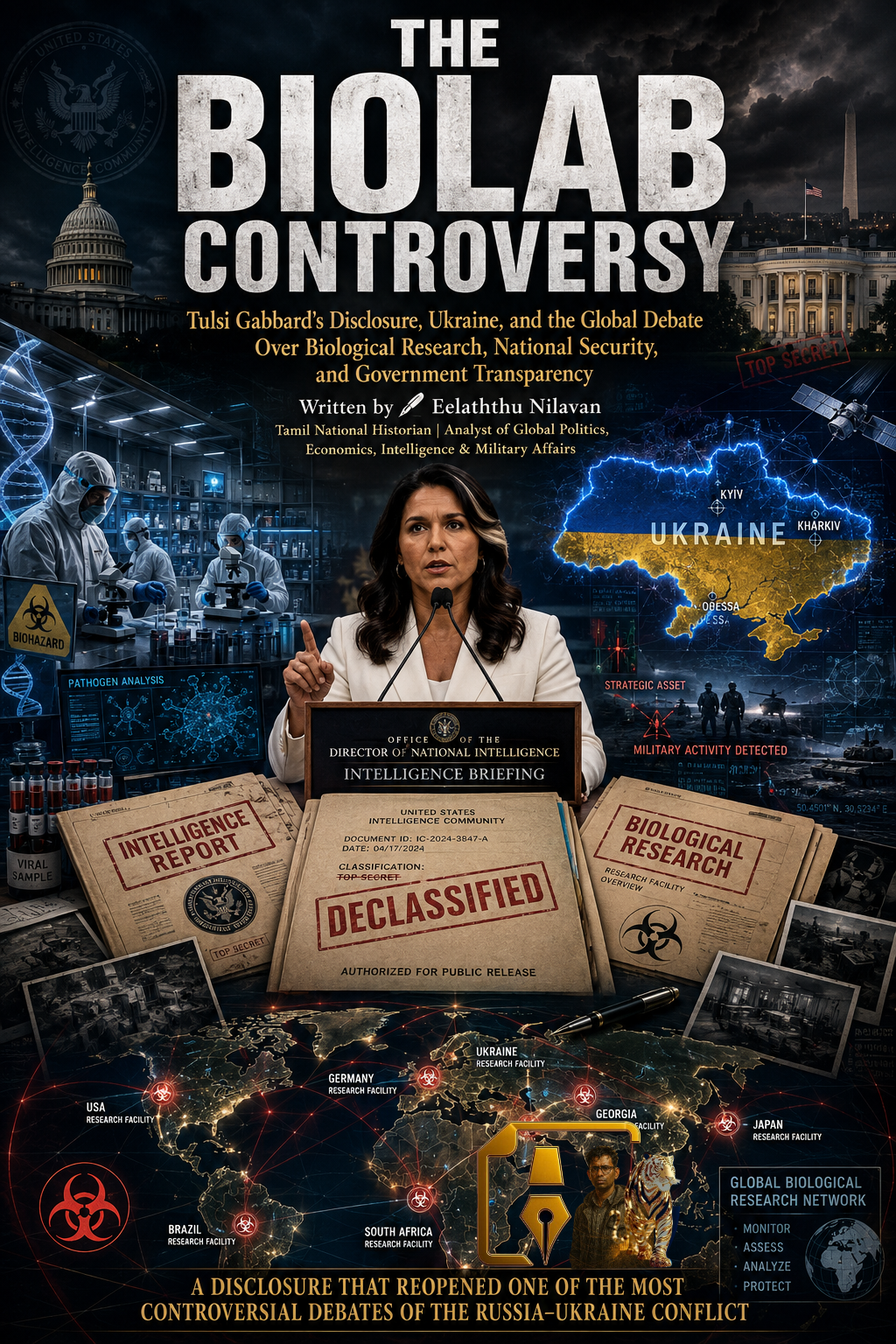

How Tulsi Gabbard’s Declassified Intelligence Reignited the Debate Over Ukraine, Biological Research, and Government Transparency
A Political Earthquake in Washington
Washington has once again become the center of a political storm following the release of declassified intelligence documents by outgoing Director of National Intelligence Tulsi Gabbard. In what may become one of the most controversial disclosures of recent years, Gabbard revealed evidence showing that the United States government has funded more than 120 biological laboratories across over 30 countries, including dozens of facilities in Ukraine.
The revelation has immediately reopened one of the most bitterly disputed debates of the Russia–Ukraine conflict. For years, allegations regarding American-supported biological laboratories in Ukraine were dismissed by many Western governments, media organizations, and policy experts as either exaggerated or linked to Russian disinformation campaigns. The newly released intelligence documents have now placed those denials under renewed scrutiny.
According to Gabbard, information concerning the scale, funding, and activities of these laboratories was not fully disclosed to the American public. She argued that government agencies and influential officials repeatedly minimized or denied the significance of these programs despite internal awareness of their existence.
What the Documents Reveal
The declassified materials released by the Office of the Director of National Intelligence describe a global network of laboratories funded through various American government programs. Many of these facilities were reportedly established to monitor infectious diseases, improve public health preparedness, and reduce biological threats emerging from former Soviet territories.
The documents indicate that some laboratories handled dangerous pathogens, including diseases such as Anthrax, Ebola, Marburg virus, Plague-related bacteria, and SARS-related pathogens. Intelligence assessments also reportedly warned that certain laboratories in Ukraine could become vulnerable during military conflict and might face risks of attack, seizure, or accidental release if security conditions deteriorated.
The disclosure has intensified concerns about the management of high-risk biological research in politically unstable regions.
The Gain-of-Function Debate Returns
One of the most controversial aspects of the release involves allegations concerning gain-of-function research.
Gain-of-function research refers to scientific experiments that alter pathogens in order to better understand how diseases spread, mutate, or become more dangerous. Supporters argue that such research is necessary to prepare vaccines and medical countermeasures before future pandemics emerge. Critics contend that the same research carries enormous risks and could potentially create pathogens capable of causing global outbreaks if accidentally released.
Gabbard’s office stated that some laboratories funded by American programs had engaged in forms of gain-of-function research with insufficient public transparency and oversight. The disclosure aligns with the broader policy direction adopted by President Donald Trump, who moved in 2025 to restrict federal support for certain categories of gain-of-function research.
The debate is likely to continue for years as scientists, policymakers, and security experts argue over where the balance should lie between scientific advancement and public safety.
Ukraine at the Center of the Storm
No country has been drawn more deeply into the controversy than Ukraine.
Since the beginning of Russia’s military operation in 2022, Moscow repeatedly claimed that Ukraine hosted laboratories funded by the United States that were conducting dangerous biological research. Western governments rejected claims that Ukraine was operating biological weapons programs and insisted that the facilities were engaged in legitimate public-health and disease-monitoring work.
The newly released intelligence does not establish that Ukraine possessed biological weapons. However, it confirms that U.S.-funded laboratories existed within Ukraine and that some handled dangerous pathogens. The documents also acknowledge that American intelligence agencies were aware of concerns regarding the vulnerability of these facilities during wartime.
As a result, both supporters and critics of previous Western narratives now claim vindication, ensuring that the issue remains politically explosive.
Anthony Fauci and the Political Fallout
Another major consequence of the disclosure is the renewed focus on former public-health officials, particularly Dr. Anthony Fauci.
Gabbard accused prominent officials and members of previous administrations of misleading the public regarding the extent of biological research programs supported by the United States abroad. Those accusations have been strongly disputed by many scientists and former government officials, who argue that international laboratory partnerships were never secret and were designed primarily for disease surveillance and biosecurity cooperation.
Regardless of where the truth ultimately lies, the political impact is already being felt. Congressional investigations, media scrutiny, and public demands for transparency are expected to intensify throughout the coming months.
Russia, NATO, and the Information War
The disclosure also has significant geopolitical implications.
For years, Russia cited concerns regarding biological research facilities in Ukraine as one element of its broader security narrative. Western governments largely dismissed those arguments as propaganda. The newly released documents do not validate all Russian claims, nor do they demonstrate the existence of biological weapons programs. However, they do confirm the presence of U.S.-supported biological laboratories and ongoing pathogen research within Ukraine.
This distinction is critical.
The debate is no longer simply about whether such laboratories existed; it is now centered on what activities took place within them, what level of oversight existed, and how much information was withheld from the public.
The information battle surrounding the Ukraine war has therefore entered a new and potentially more complicated phase.
The Larger Question: Who Controls Dangerous Science?
Beyond politics, the controversy raises a fundamental question about the future of biological research.
Modern biotechnology possesses extraordinary power. The same scientific techniques capable of developing vaccines can also be used to modify pathogens. As biological technology becomes increasingly sophisticated, governments around the world face growing pressure to ensure that research remains transparent, accountable, and secure.
The Gabbard disclosures have reignited fears that international biological research networks may be operating beyond effective public oversight. Whether those fears are justified or exaggerated will likely become the subject of future investigations.
Conclusion: A Disclosure With Global Consequences
Tulsi Gabbard’s final weeks in office may ultimately be remembered for a disclosure that transformed an already controversial debate into a major international issue. The documents released by her office have not ended the argument over biological laboratories, gain-of-function research, or Ukraine. Instead, they have opened a new chapter in a dispute that touches national security, scientific ethics, public trust, and global geopolitics.
As governments, researchers, and intelligence agencies respond to these revelations, one reality has become clear: the debate over biological research and transparency is far from over. The political consequences may reverberate across Washington, Kyiv, Moscow, and beyond for years to come.
𝐖𝐫𝐢𝐭𝐭𝐞𝐧 𝐛𝐲:


𝐄𝐞𝐥𝐚𝐭𝐡𝐭𝐡𝐮 𝐍𝐢𝐥𝐚𝐯𝐚𝐧
Tamil National Historian | Analyst of Global Politics, Economics, Intelligence & Military Affairs
13/06/2026