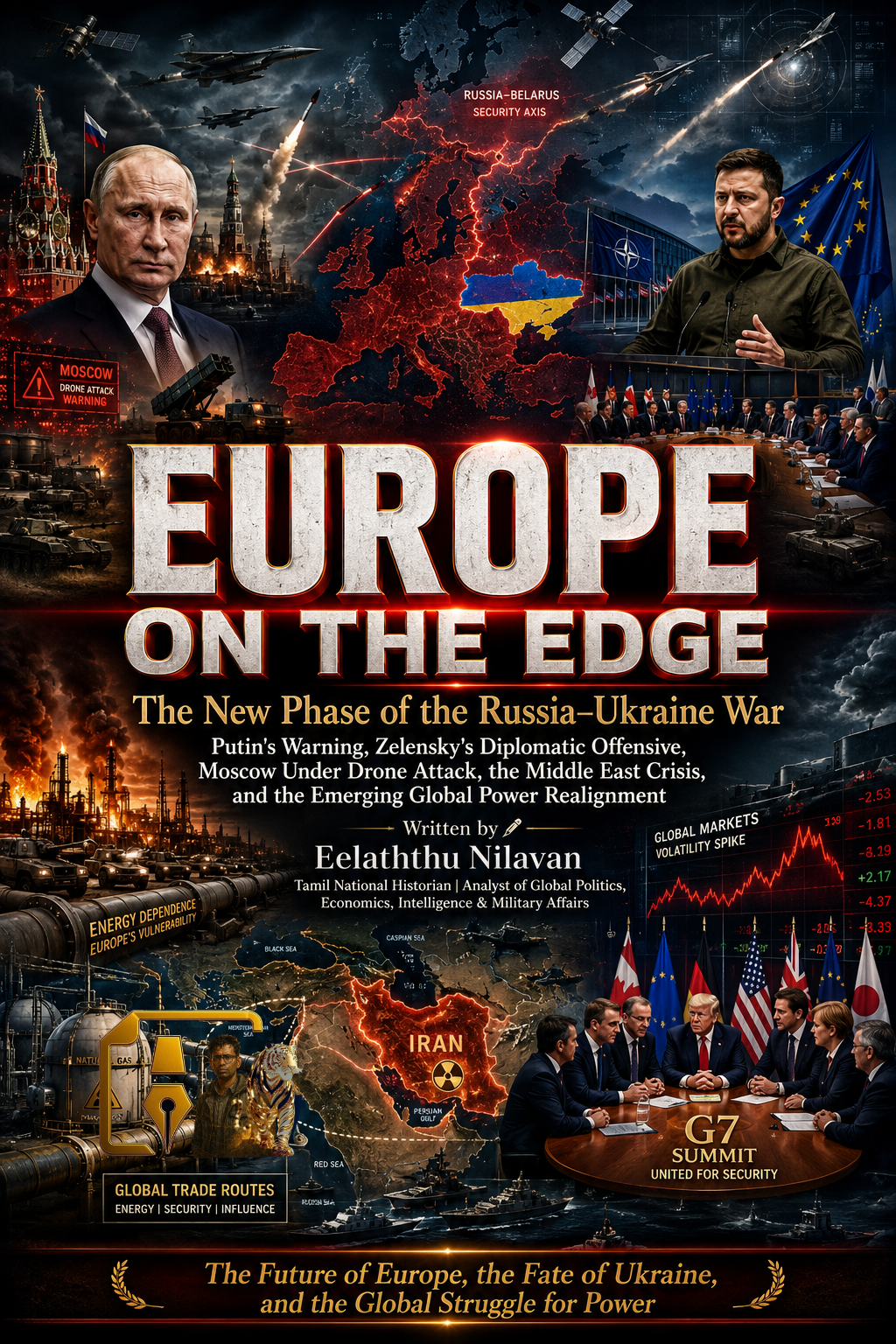

The Russia–Ukraine War Enters a New Phase: Putin’s Warning, Zelensky’s Diplomatic Offensive, Moscow Under Attack, and Growing Global Tensions
A Dangerous New Turning Point in the Russia–Ukraine War
The Russia–Ukraine war has entered yet another volatile phase, marked by intensifying military operations, competing diplomatic initiatives, escalating attacks on critical infrastructure, and growing fears of a wider confrontation involving major global powers. What began as a regional conflict in Eastern Europe has evolved into one of the most significant geopolitical struggles of the twenty-first century, affecting global energy markets, international security arrangements, military alliances, and the balance of power between Russia and the West.
Recent developments have underscored how rapidly the conflict is expanding beyond the battlefield. Russian President Vladimir Putin’s latest emergency address from the Kremlin, Ukrainian President Volodymyr Zelensky’s renewed diplomatic campaign, Ukrainian drone strikes deep inside Russian territory, and debates among G7 leaders have collectively heightened concerns that the conflict could enter a far more dangerous stage.
Putin’s Emergency Kremlin Address Sends Shockwaves Across the World
Russian President Vladimir Putin’s latest speech has generated immediate international attention. Delivered from the Kremlin at a moment of heightened tensions in the Middle East and Eastern Europe, the speech was widely interpreted as a warning directed not only at Ukraine but also at Western governments considering deeper military involvement in regional conflicts.
Putin’s remarks regarding Iran were particularly significant. Moscow appears increasingly concerned about Western military actions that could further destabilize the Middle East. Russia has invested heavily in maintaining strategic partnerships across the region, and any expansion of military operations involving Iran could directly challenge Russian interests.
The speech reflects Moscow’s broader strategic objective: preventing further Western expansion of military influence while preserving Russia’s role as a central power broker in global affairs. Putin’s comments also signal that the Kremlin increasingly views the wars in Ukraine and the Middle East as interconnected geopolitical contests involving competing visions of global order.
For Western policymakers, the speech serves as a reminder that Russia is prepared to frame international crises as part of a wider struggle against what it perceives as Western dominance.
Zelensky’s Diplomatic Counteroffensive and the Push for European Union Membership
While Russia projects strength through military and strategic messaging, Ukraine continues to pursue a dual-track strategy that combines military resistance with aggressive diplomacy.
President Volodymyr Zelensky has intensified calls for the European Union to accelerate Ukraine’s accession process. Speaking before European officials, he argued that Ukraine has fulfilled the requirements necessary to advance membership negotiations and deserves rapid integration into European institutions.
For Kyiv, EU membership is not simply an economic objective. It represents a strategic guarantee that Ukraine’s future lies firmly within the European political and security framework. Ukrainian leaders view accession as both a symbolic and practical response to Russian aggression.
Zelensky’s message to European leaders is clear: every step toward Ukrainian membership strengthens Europe’s collective security and demonstrates that Russian military pressure cannot reverse Ukraine’s western trajectory.
The debate within Europe, however, remains complex. While many governments strongly support Ukraine’s aspirations, others remain concerned about the economic, political, and institutional challenges associated with rapid enlargement.
The Search for Peace Talks and the Challenge Facing Putin
One of the most intriguing developments is Zelensky’s renewed effort to establish direct negotiations with Russian President Vladimir Putin.
According to Ukrainian officials, Kyiv has repeatedly proposed meetings in various formats designed to create opportunities for meaningful dialogue. Discussions reportedly included potential talks involving the United States, France, and other major democratic powers. More recently, Zelensky discussed with U.S. President Donald Trump the possibility of hosting negotiations in the United States.
The diplomatic logic behind such proposals is straightforward. By offering multiple venues and formats, Ukraine seeks to demonstrate its willingness to negotiate while simultaneously increasing international pressure on Moscow.
For Russia, however, negotiations remain closely tied to battlefield realities. The Kremlin continues to insist that any serious talks must acknowledge what Moscow considers the strategic realities created by the war.
As both sides continue military operations, the prospects for a breakthrough remain uncertain. Yet the continued discussion of negotiations demonstrates that diplomacy remains an important component of the broader conflict.
Moscow Comes Under Direct Attack
One of the most significant military developments has been Ukraine’s expanding drone campaign against Russian energy infrastructure.
The reported strike on Moscow’s largest oil refinery represents a major escalation. Unlike previous attacks targeting facilities in border regions or distant industrial zones, this operation struck a critical component of the Russian capital’s energy system.
The refinery processes millions of tons of crude oil annually and plays a crucial role in supplying fuel to the Moscow region. Although Russian authorities reported no casualties, the symbolic significance of the attack is substantial.
The strike demonstrates Ukraine’s growing capability to project military pressure deep inside Russian territory. It also highlights the increasing importance of long-range drone warfare, which has become one of the defining features of the conflict.
For Moscow, attacks on strategic energy infrastructure create both practical and political challenges. They expose vulnerabilities in air defense systems while raising concerns about the security of critical national assets.
The Energy War Intensifies
The attack on Moscow’s refinery is part of a broader campaign targeting Russia’s energy sector.
Since the beginning of 2026, strikes against Russian refineries, storage facilities, and energy infrastructure have reportedly increased significantly. These operations aim to reduce fuel production, increase economic pressure, and complicate Russia’s ability to sustain military operations.
Energy has always been a central dimension of the conflict. Russia has historically leveraged its position as a major energy exporter to exert influence abroad, while Ukraine and its partners increasingly view energy infrastructure as a legitimate strategic target.
The result is a growing energy war that extends far beyond the front lines and affects global markets, transportation systems, and industrial production.
G7 Leaders Face Growing Divisions
At the latest G7 Summit, leaders confronted an increasingly complex international environment.
The gathering brought together governments that broadly support Ukraine but often differ on specific questions regarding military aid, sanctions, diplomacy, and long-term strategy.
The presence of President Donald Trump has added another layer of uncertainty. Trump’s calls for negotiations and alternative approaches to conflict resolution have generated debate among allies seeking to maintain a unified front against Russia.
Meanwhile, Zelensky used the summit as an opportunity to strengthen international support and reinforce Ukraine’s position as a central issue on the global agenda.
The summit highlights a growing reality: while Western nations remain broadly aligned in supporting Ukraine, differences over how to achieve peace are becoming increasingly visible.
Britain’s Nuclear Energy Agreement with Ukraine
Another important development involves the United Kingdom’s decision to provide support for Ukraine’s nuclear energy sector through a £210 million enriched uranium agreement with Energoatom.
Supporters argue that the arrangement will help secure Ukraine’s electricity generation capabilities and reduce vulnerability to attacks on energy infrastructure.
Critics, however, point to ongoing corruption investigations involving Energoatom and raise concerns regarding transparency and oversight.
From a strategic perspective, the agreement reflects a broader Western effort to strengthen Ukraine’s long-term resilience. Energy security has become a critical component of national security, and ensuring reliable electricity generation remains essential for both civilian and military stability.
Russia is likely to view the agreement as another example of Western governments deepening their involvement in Ukraine’s strategic sectors.
Legal Battles Continue Beyond the Battlefield
The conflict between Russia and Ukraine is not confined to military operations. It also continues through international legal institutions.
A recent arbitration ruling reportedly rejected several Ukrainian maritime claims concerning Crimea, the Kerch Strait, the Sea of Azov, and related issues. Moscow has presented the decision as validation of its legal position on key strategic waterways.
Regardless of differing interpretations, the ruling demonstrates how legal disputes remain intertwined with broader geopolitical competition.
Control of maritime routes, access to ports, and questions of sovereignty continue to shape the strategic calculations of both sides.
The Emerging Geopolitical Landscape
Taken together, these developments reveal a conflict that is simultaneously military, diplomatic, economic, legal, and geopolitical.
Russia seeks to maintain strategic depth, preserve influence, and resist what it sees as Western encroachment. Ukraine aims to secure international support, deepen integration with Europe, and increase pressure on Moscow through both military and diplomatic means.
The United States, Europe, and other global powers remain deeply involved, while events in the Middle East increasingly intersect with the broader confrontation between Russia and the West.
As drone warfare expands, diplomatic efforts continue, and global alliances adjust to new realities, the Russia–Ukraine war is entering a phase characterized by greater complexity and greater uncertainty.
Conclusion: Europe at the Edge
Europe stands at a critical historical crossroads. The decisions made in Moscow, Kyiv, Washington, Brussels, London, and other capitals over the coming months could shape the future security architecture of the continent for decades.
Putin’s warning, Zelensky’s diplomatic initiatives, attacks on strategic infrastructure, disputes over energy security, and divisions among Western allies all point toward a conflict that is far from resolution.
The war is no longer merely a struggle over territory. It has become a contest over international order, political influence, economic resilience, and the future balance of power in Eurasia.
Whether the next chapter leads toward negotiations or deeper confrontation remains uncertain. What is clear, however, is that the world is watching a geopolitical transformation unfold in real time—and Europe increasingly finds itself on the front line of that transformation.
𝐖𝐫𝐢𝐭𝐭𝐞𝐧 𝐛𝐲: