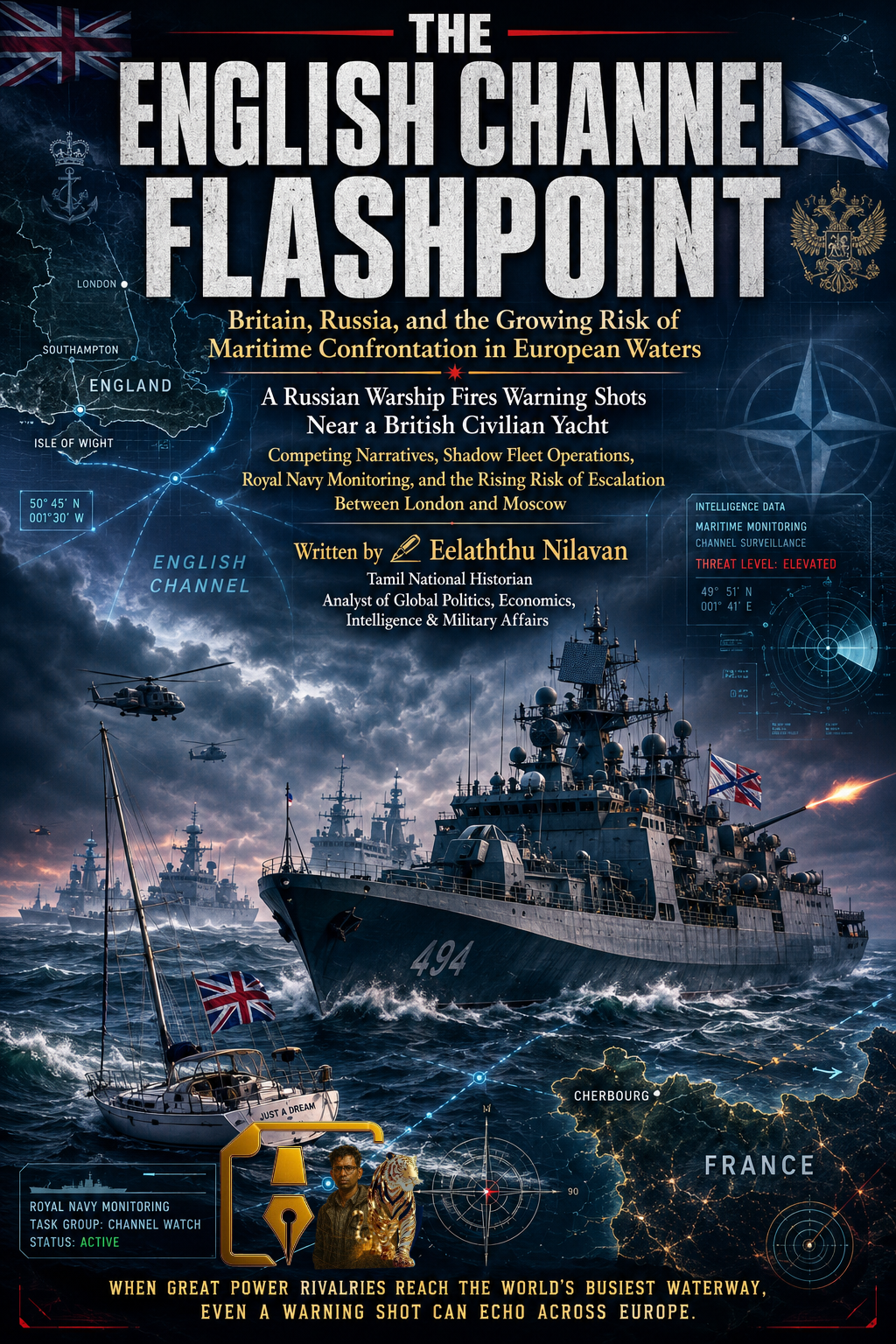

Britain, Russia, and the Growing Risk of Maritime Confrontation in European Waters
A Dangerous Encounter in the English Channel
The English Channel, one of the world’s busiest and most strategically significant maritime corridors, became the scene of an alarming military confrontation when the Russian Navy frigate Admiral Grigorovich reportedly fired live warning shots near a British-flagged civilian yacht operating in international waters south of the Isle of Wight.
Although no injuries were reported and no direct hits were made against the vessel, the incident immediately attracted the attention of British military authorities and political leaders. In an era marked by increasing geopolitical competition between Russia and the West, even a seemingly limited encounter at sea has the potential to trigger wider diplomatic consequences.
What makes this event particularly significant is not merely the firing of warning shots itself, but the broader strategic environment in which it occurred. Relations between London and Moscow have deteriorated dramatically since Russia’s invasion of Ukraine, and maritime interactions between Russian and NATO-linked vessels are now taking place under conditions of heightened suspicion and military vigilance.
Conflicting Narratives: Moscow versus London
As is often the case in modern geopolitical crises, the facts surrounding the encounter are being interpreted through two sharply contrasting narratives.
According to the Russian Ministry of Defense, the civilian yacht approached the Russian frigate in a manner that posed a navigational risk. Russian officials claim that repeated radio calls, warning signals, signal flares, and audible alarms were ignored by the yacht’s crew. Moscow argues that warning shots were therefore necessary to prevent what it described as a potentially dangerous situation.
The British couple aboard the yacht strongly reject these allegations. They insist that they immediately altered course after becoming aware of the Russian vessel’s concerns and were never on a collision trajectory. According to their account, the subsequent gunfire was disproportionate, intimidating, and completely unnecessary.
This discrepancy highlights a recurring challenge in international maritime incidents. Without independent verification from surveillance data, naval tracking systems, or third-party observers, competing narratives often become part of a larger information battle between rival states.
The Strategic Importance of the English Channel
The English Channel is far more than a commercial shipping route. It is a critical strategic artery connecting the Atlantic Ocean with the North Sea and the broader European maritime network.
Every year, hundreds of thousands of commercial vessels transit through these waters, carrying energy supplies, industrial goods, military equipment, and vital trade commodities.
Because of its strategic significance, the Channel has historically been viewed as a sensitive security zone for the United Kingdom. Any military activity by foreign powers in these waters inevitably attracts close monitoring from British defense authorities.
The presence of a Russian warship operating in proximity to civilian traffic therefore carries both practical and symbolic implications. While international law permits naval vessels to transit through international waters, persistent military operations near major NATO states inevitably raise concerns about intelligence gathering, strategic signaling, and potential coercion.
Russia’s Shadow Fleet and the Sanctions War
A crucial backdrop to the incident is the ongoing struggle over Russia’s so-called “shadow fleet.”
Since Western sanctions were imposed on Russian energy exports, Moscow has increasingly relied on a network of aging tankers, complex ownership structures, and indirect shipping arrangements to continue exporting oil and petroleum products around the world.
Western governments accuse these vessels of helping Russia circumvent economic restrictions imposed following the Ukraine conflict. Russia, however, maintains that many of these sanctions are illegitimate and politically motivated.
The Admiral Grigorovich has reportedly been involved in escorting Russian-linked commercial vessels through sensitive maritime areas, including the English Channel. Such escorts are intended not only to provide security but also to demonstrate Russia’s determination to protect its economic interests despite Western pressure.
The result is a growing overlap between economic warfare and military activity, creating new opportunities for misunderstandings and confrontation.
The Royal Navy’s Expanding Role
British authorities have confirmed that Royal Navy assets continue to monitor Russian naval movements around the United Kingdom.
This policy reflects a broader NATO strategy aimed at tracking Russian military activity across European waters. Similar monitoring operations occur in the Baltic Sea, the North Sea, the Mediterranean, and the Arctic.
The Royal Navy’s shadowing operations serve multiple purposes. They ensure maritime awareness, reassure allies, gather intelligence, and provide rapid response capabilities should an emergency arise.
However, the close proximity of opposing naval forces inevitably increases operational risks. Even routine maneuvers can be misinterpreted, particularly during periods of heightened political tension.
Military analysts frequently warn that accidental escalation is often more dangerous than deliberate aggression because it can rapidly spiral beyond the intentions of either side.
Growing Tensions Between Britain and Russia
The incident occurred at a time when relations between London and Moscow are among the worst seen since the Cold War.
The United Kingdom remains one of Ukraine’s strongest supporters, providing military aid, intelligence assistance, training programs, and diplomatic backing.
Russia, meanwhile, increasingly portrays Britain as one of the leading Western powers driving anti-Russian policies.
Recent disputes over sanctions enforcement, intelligence operations, cyber security concerns, and military support for Ukraine have deepened mistrust between the two countries.
Against this backdrop, even relatively minor incidents at sea can quickly assume broader political significance.
Prime Minister Keir Starmer’s condemnation of the encounter as “reckless” reflects growing concern within Britain that Russian military activities are becoming more assertive and unpredictable.
The Risk of Miscalculation
Perhaps the most important lesson from this episode is the danger posed by miscalculation.
Throughout history, many international crises have begun with relatively small incidents involving naval vessels, aircraft, or border patrols.
When military forces operate in close proximity, decision-making often occurs within seconds. Communication failures, navigational misunderstandings, or excessive reactions can produce consequences far beyond the original event.
In the current geopolitical environment, where NATO and Russian forces interact regularly across multiple theaters, the margin for error is shrinking.
Analysts warn that while neither Britain nor Russia appears to seek direct military confrontation, repeated encounters increase the probability of an unintended escalation.
Such risks are especially acute in contested maritime spaces where civilian and military traffic frequently overlap.
A New Maritime Front in the Wider Geopolitical Contest
The warning-shot incident in the English Channel may ultimately prove to be a relatively minor event in military terms. Nevertheless, it serves as a powerful reminder of the increasingly complex security environment surrounding Europe.
The confrontation illustrates how the Russia-Ukraine conflict now extends far beyond the battlefield itself. Economic sanctions, maritime security, intelligence operations, energy transportation, and naval deployments have all become interconnected elements of a wider geopolitical struggle.
As Britain, NATO, and Russia continue to pursue competing strategic objectives, incidents such as this are likely to become more frequent.
The challenge facing policymakers is to prevent these encounters from evolving into larger crises while maintaining national security and strategic deterrence.
For now, the waters of the English Channel remain calm. Yet beneath the surface lies a growing contest of power, influence, and strategic resolve—one that could shape European security for years to come.
Conclusion
The encounter between the Russian frigate Admiral Grigorovich and the British civilian yacht represents more than a maritime safety dispute. It symbolizes the broader deterioration of relations between Russia and the West, the growing militarization of strategic waterways, and the fragile balance that now exists between deterrence and escalation.
Whether viewed as a justified security action or an unnecessary act of intimidation, the incident underscores a reality that cannot be ignored: Europe’s maritime frontiers are becoming increasingly tense, and the possibility of a future crisis arising from a single misjudgment remains very real.
In an age of geopolitical confrontation, even a warning shot can echo far beyond the sea where it was fired.
𝐖𝐫𝐢𝐭𝐭𝐞𝐧 𝐛𝐲: