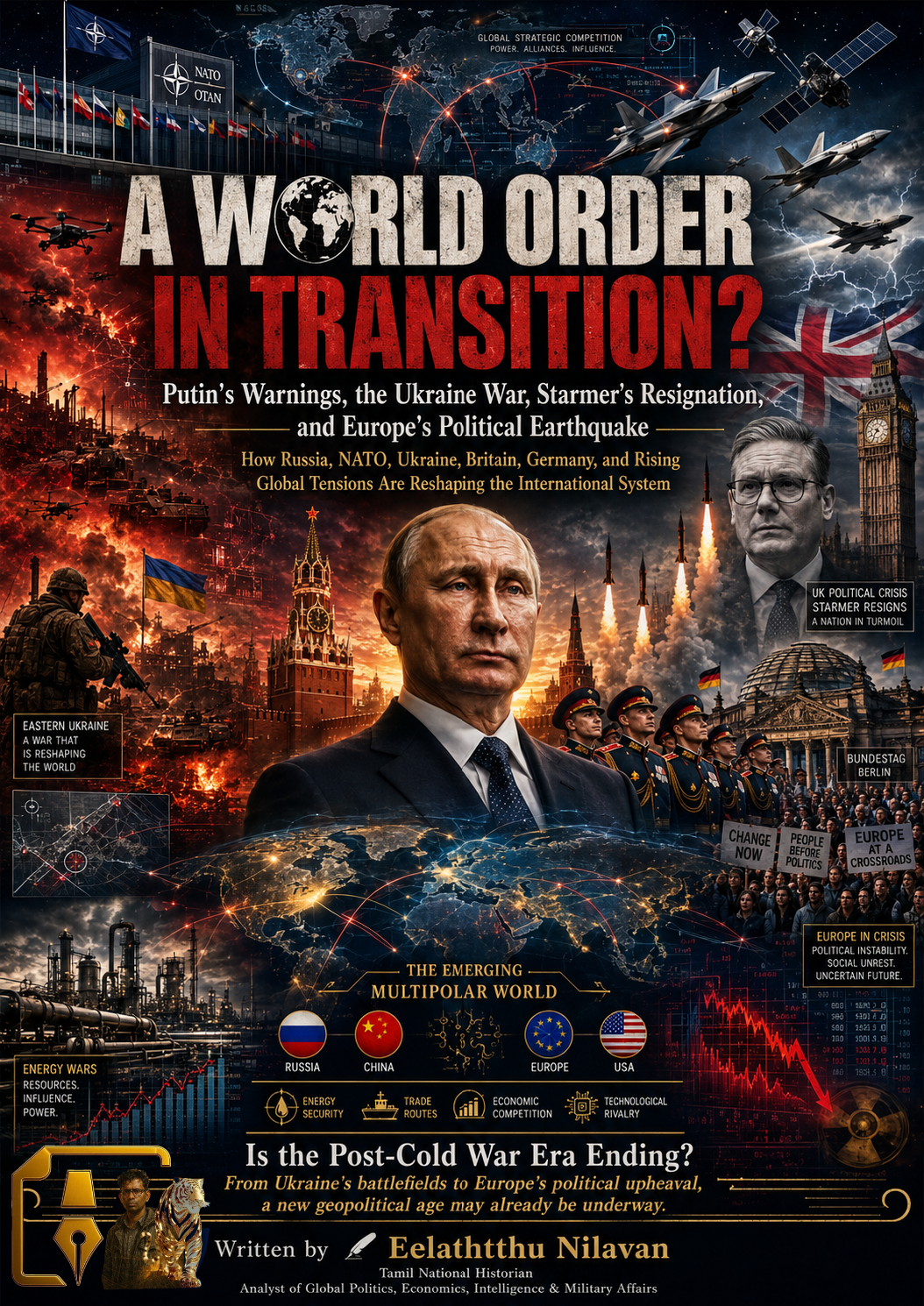

New Geopolitical Alignments Emerging Under the Shadow of a NATO–Russia Confrontation
One Speech, One War, One Resignation – Where Is the World Heading?
The year 2026 may ultimately be remembered as a turning point in modern international politics. A series of seemingly separate developments have converged to create a moment of profound geopolitical uncertainty.
Russian President Vladimir Putin’s military graduation address, his reported off-script remarks captured during informal conversations with senior officers, the continuing war in Ukraine, North Korea’s growing role in the conflict, and the resignation of British Prime Minister Keir Starmer have together sparked debate about whether the international order is entering a new phase.
While these events originate in different capitals and involve different actors, they all point toward the same underlying question: Is the world moving away from the post-Cold War order and toward a new era defined by strategic rivalry, political fragmentation, and competing centers of power?
Putin’s Warning: “Russia Is Ready for Direct Conflict with NATO”
Addressing graduates of Russia’s elite military academies, President Vladimir Putin delivered one of his strongest warnings yet regarding relations between Russia and the West.
According to Putin, Western governments have moved beyond simply supporting Ukraine and are now openly preparing for a direct confrontation with Russia. He argued that NATO governments are increasingly using the narrative of a “Russian threat” to justify unprecedented increases in military spending and rapid rearmament across Europe.
From Moscow’s perspective, this trend is not merely defensive. Russian officials portray it as evidence that Western powers are preparing for a prolonged geopolitical struggle that could eventually escalate into direct military confrontation.
Putin emphasized that Russia remains fully prepared to respond to both external and internal threats and that maintaining strategic deterrence remains a central pillar of Russian national security policy.
The Revival of Russia’s Nuclear Triad
A major theme of Putin’s speech was the modernization of Russia’s nuclear triad—the land-based, naval, and air components of the country’s strategic nuclear forces.
Putin stated that Russia continues to prioritize the modernization of its strategic deterrent capabilities in response to what Moscow perceives as an increasingly hostile international environment.
According to Russian officials, more than one thousand different weapons systems have been tested in real combat conditions since the beginning of the war in Ukraine. These systems reportedly include:
• Advanced drones and unmanned aerial vehicles (UAVs)
• Robotic battlefield systems
• Long-range missile technologies
• Electronic warfare capabilities
• Artificial intelligence-assisted military platforms
The Kremlin argues that battlefield experience is being directly integrated into defense production through a continuous feedback loop between frontline forces and military industries. This process allows weapons to be modified and improved based on real-world combat performance.
North Korea: The Hidden Beneficiary of the Ukraine War?
One of the most significant developments emerging from the conflict is the growing military relationship between Russia and North Korea.
Military analysts increasingly view the war in Ukraine as a large-scale testing environment for North Korean missile technology.
Particular attention has focused on the Hwasong-11A, commonly known as the KN-23 tactical ballistic missile. Reports suggest that extensive battlefield use has enabled North Korea to gather valuable operational data, leading to rapid improvements in missile performance and accuracy.
Some analysts claim that the missile’s circular error probable (CEP)—a measure of accuracy—has been significantly reduced, making it a much more effective battlefield weapon than earlier versions.
The conflict has also reportedly accelerated technological exchanges between Moscow and Pyongyang. Experts note similarities between the KN-23 and Russia’s Iskander-M missile system, particularly in their ability to perform unpredictable terminal maneuvers designed to evade air defense systems.
Meanwhile, reports continue to circulate regarding newer variants featuring hypersonic glide vehicle technology, which could further complicate missile defense efforts in future conflicts.
The Ukraine War: Who Holds the Advantage?
Putin’s speech presented an optimistic assessment of Russia’s battlefield position.
According to the Russian president, Russian forces continue advancing along multiple sectors of the front line and are steadily increasing pressure on Ukrainian positions.
He characterized Ukrainian drone attacks and strikes against infrastructure as attempts to create uncertainty within Russian society rather than actions capable of altering the strategic balance of the war.
Putin also dismissed recent diplomatic initiatives from Kyiv, suggesting that Ukrainian peace proposals lack sincerity and are contradicted by continued military operations.
However, it is important to note that assessments of the battlefield differ significantly depending on the source. Ukrainian officials and Western governments frequently dispute Russian claims regarding territorial gains, force strength, and overall momentum.
As a result, the war remains not only a military conflict but also a contest of competing narratives.
Keir Starmer’s Resignation: Britain’s Political Shockwave
At the same time, Britain has entered a new period of political uncertainty following the resignation of Prime Minister Keir Starmer.
After only two years in office, Starmer’s departure has intensified concerns about the long-term stability of British politics.
His resignation makes him the latest in a succession of British leaders who have struggled to maintain political authority in an era marked by economic challenges, social divisions, and shifting public expectations.
The rapid turnover of leadership has become a defining characteristic of modern British politics, raising questions about whether the country’s political institutions are adequately equipped to address the structural issues facing the nation.
For many observers, Starmer’s resignation is not merely an isolated political event but a symptom of broader pressures affecting democratic governments throughout the West.
Germany, AfD, and Europe’s Political Realignment
The reaction from Germany was particularly noteworthy.
Figures associated with the Alternative for Germany (AfD) portrayed Starmer’s resignation as evidence that mainstream political parties across Europe are losing public confidence.
Supporters of populist and anti-establishment movements argue that traditional political elites have failed to address key concerns shared by millions of European voters, including:
• Rising inflation
• Increasing energy costs
• Immigration pressures
• Housing affordability
• Economic stagnation
• Concerns over national sovereignty
Across Europe, political movements challenging the traditional center-left and center-right consensus continue to gain support, creating uncertainty about the future direction of European politics.
Is Europe Entering a New Political Era?
The political debate unfolding across Europe increasingly transcends the traditional left-versus-right divide.
Instead, many of today’s most significant political disputes revolve around larger strategic questions:
• Globalization versus national sovereignty
• Open borders versus controlled migration
• Military expansion versus domestic investment
• Strategic autonomy versus transatlantic dependence
• Liberal internationalism versus national conservatism
As economic and geopolitical pressures intensify, these competing visions are reshaping electoral politics across the continent.
The result is a political environment that is becoming increasingly fragmented, volatile, and unpredictable.
Conclusion: A New Turning Point in World Politics
Putin’s warnings, the continuing war in Ukraine, North Korea’s growing military role, and the political upheaval represented by Keir Starmer’s resignation are not isolated developments.
Together, they reflect deeper transformations occurring across the international system.
Whether these events ultimately signal the emergence of a multipolar world order remains uncertain. However, they clearly illustrate a period in which established assumptions about security, power, and political stability are being challenged.
The post-Cold War era was built upon expectations of expanding cooperation, economic integration, and relative geopolitical stability.
Today, those expectations are increasingly under strain.
History may ultimately view 2026 not as another ordinary year, but as a moment when the foundations of a new global order began to take shape.
As governments, military alliances, and political movements adapt to rapidly changing realities, one fact is becoming increasingly difficult to ignore:
The world is entering one of the most consequential geopolitical transitions of the twenty-first century.
𝐖𝐫𝐢𝐭𝐭𝐞𝐧 𝐛𝐲: