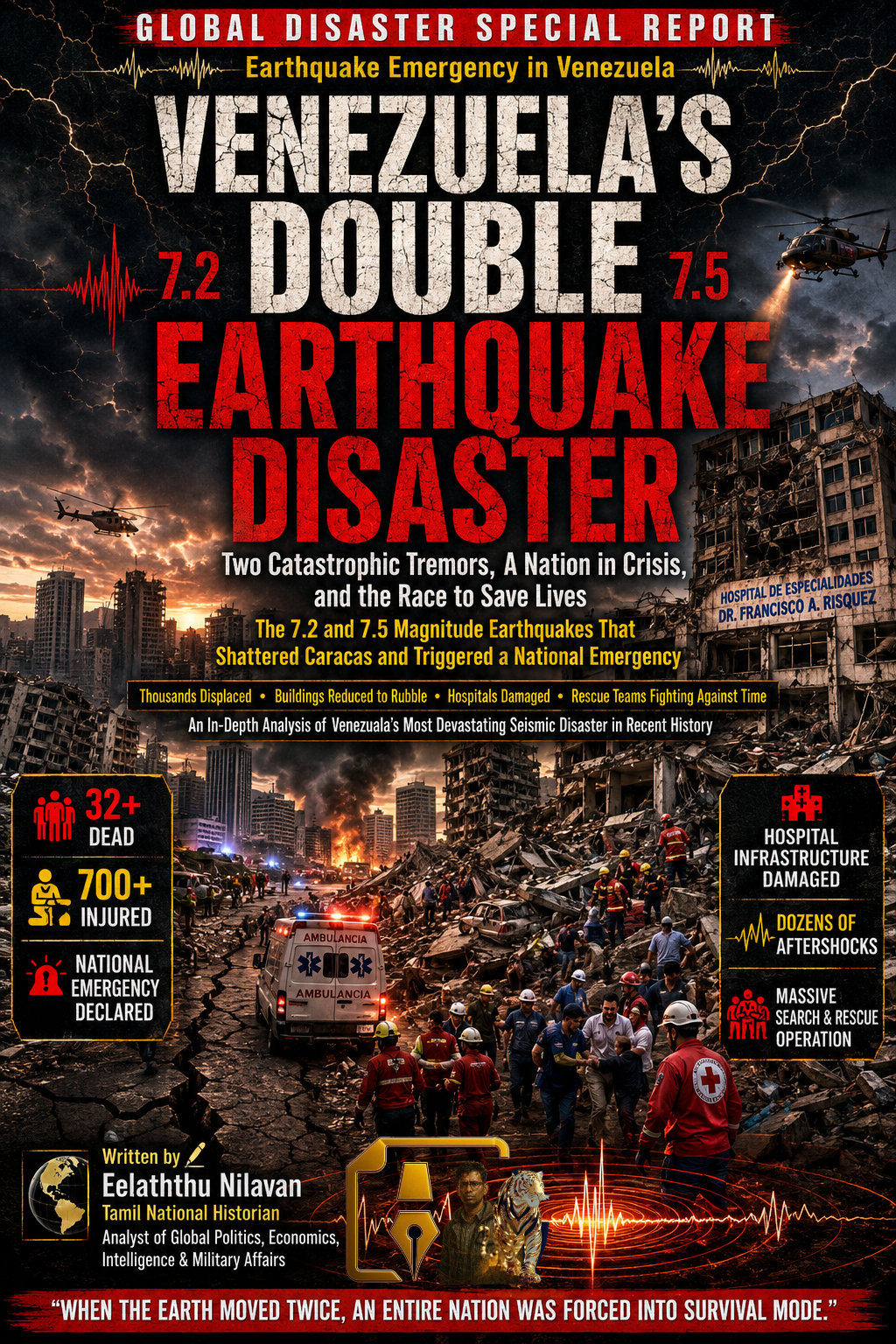

“Two Catastrophic Tremors in Less Than a Minute — Caracas Faces One of the Worst Natural Disasters in Modern Venezuelan History”
More Than 32 Dead • Over 700 Injured • Thousands Feared Trapped or Missing • Nationwide State of Emergency Declared
A Nation Transformed in Seconds
Venezuela has been plunged into a state of mourning and uncertainty after a powerful doublet earthquake sequence struck the country, causing widespread destruction across the capital city of Caracas and several surrounding regions.
According to preliminary reports, the first earthquake measured 7.2 in magnitude and was followed less than a minute later by a second and even stronger 7.5 magnitude tremor. The back-to-back earthquakes created a rare and highly destructive seismic event known as a “doublet earthquake,” dramatically increasing the damage caused by the disaster.
Residents described hearing deep underground rumbling before buildings began swaying violently. Within moments, streets filled with terrified citizens fleeing homes, offices, schools, hospitals, and shopping centers as the ground continued to shake beneath them.
For many Venezuelans, the event became a terrifying reminder of the destructive power of nature and the vulnerability of urban infrastructure when confronted with a major seismic catastrophe.
Caracas Suffers Extensive Structural Damage
The Venezuelan capital, Caracas, appears to have suffered some of the worst damage.
Entire sections of residential and commercial buildings collapsed as the earthquakes shook the city. Emergency responders reported severe structural failures in multiple neighborhoods, with roads cracked, utility lines damaged, and large amounts of debris blocking major transportation routes.
Witnesses described scenes of chaos as dust clouds rose from collapsing structures and emergency sirens echoed across the city. Many residents spent the night outdoors, fearful that aftershocks could trigger additional collapses.
Authorities have warned that the full extent of the destruction may not be known for several days as damage assessments continue throughout affected regions.
Specialist Hospital Among Damaged Facilities
One of the most alarming developments involved the Dr. Francisco A. Risquez Ophthalmology Specialty Hospital in Caracas.
Reports indicate that significant structural damage occurred in the lower floors of the medical facility, forcing emergency evacuations of patients and healthcare workers. Hospital administrators immediately initiated emergency protocols while engineers conducted safety inspections.
The damage to healthcare infrastructure has complicated rescue and medical operations, particularly as hospitals across Caracas struggle to accommodate hundreds of injured citizens.
Doctors and emergency personnel have been working around the clock, often under difficult conditions, to provide treatment to earthquake victims while coping with damaged facilities and limited resources.
The situation highlights how natural disasters can rapidly overwhelm critical healthcare systems during large-scale emergencies.
Rising Casualties and Fear of Higher Death Toll
Acting President Delcy Rodríguez confirmed that at least 32 people have been killed and more than 700 injured across Venezuela.
However, officials have cautioned that these figures are expected to rise significantly as rescue teams continue searching collapsed structures and isolated communities.
Many buildings remain unstable, making search operations dangerous and time-consuming. Emergency crews are using specialized equipment, search dogs, and thermal imaging technology in an effort to locate survivors trapped beneath rubble.
In several severely affected districts, families continue waiting anxiously for news about missing relatives.
The first seventy-two hours following a major earthquake are considered critical for rescue operations, and authorities are racing against time to save as many lives as possible.
State of Emergency Declared Across the Country
In response to the disaster, the Venezuelan government declared a nationwide state of emergency.
Military units, civil defense organizations, firefighters, police forces, and volunteer rescue groups have been deployed across affected areas. Temporary shelters have been established to accommodate thousands of displaced residents who can no longer safely return to their homes.
Government officials have prioritized three immediate objectives:
1. Search and rescue operations.
2. Emergency medical assistance.
3. Restoration of essential services including electricity, communications, and water supplies.
Several schools and public buildings have been converted into emergency relief centers to support affected communities.
Aftershocks Continue to Threaten Survivors
Even after the main earthquakes, dozens of aftershocks have continued to rattle parts of Venezuela.
Seismologists warn that powerful aftershocks could persist for days or even weeks following the initial event. These secondary tremors present a significant danger because weakened buildings may collapse without warning.
As a result, many residents remain reluctant to return indoors despite difficult weather conditions and limited shelter availability.
The psychological impact has been profound. Survivors describe constant anxiety, sleepless nights, and fear that another major earthquake could strike at any moment.
International Community Offers Assistance
Governments and humanitarian organizations around the world have begun offering support to Venezuela.
Several countries have pledged emergency relief supplies, medical assistance, engineering specialists, and urban search-and-rescue teams.
International disaster response organizations are coordinating efforts to provide food, clean water, temporary shelter, and emergency medical resources for affected populations.
Satellite imagery and aerial surveys are also being used to identify the hardest-hit regions and improve the efficiency of rescue operations.
The global response reflects the scale of the disaster and the urgent need for international cooperation during humanitarian crises of this magnitude.
Why This Earthquake Was Especially Destructive
Earthquake experts note that the disaster’s severity was amplified by the unusual nature of the seismic sequence.
A doublet earthquake occurs when two major earthquakes of similar strength strike within a very short period of time and in close proximity. The first event weakens buildings and infrastructure, while the second often delivers the devastating blow that causes widespread collapse.
This phenomenon can dramatically increase casualties and structural damage compared to a single earthquake of comparable magnitude.
Engineers are now assessing whether existing construction standards in affected areas were sufficient to withstand such a rare and powerful event.
A Long Night for Venezuela
Across Caracas and other affected regions, thousands of people spent the night in parks, open spaces, sports fields, and temporary shelters.
Emergency lights illuminated streets filled with debris while rescue workers searched through the darkness for signs of life beneath collapsed buildings.
Families gathered around radios and mobile phones, desperately seeking information about loved ones. Hospitals remained crowded, and emergency personnel worked tirelessly despite exhaustion.
For many Venezuelans, the disaster has become one of the most traumatic moments in recent national memory.
Conclusion: Venezuela Faces a Historic Challenge
The twin earthquakes that struck Venezuela represent one of the most serious natural disasters to affect the country in decades.
Lives have been lost, communities have been shattered, and critical infrastructure has suffered extensive damage. Yet amid the tragedy, stories of courage, sacrifice, and resilience continue to emerge from the disaster zone.
As rescue operations continue and authorities work to assess the full scale of the catastrophe, the world watches closely.
The coming days will determine how many more survivors can be found, how quickly recovery efforts can begin, and how Venezuela rebuilds after one of the most devastating seismic events in its modern history.
For now, the nation remains focused on a single mission: saving lives, supporting survivors, and finding hope amid the ruins.
𝐖𝐫𝐢𝐭𝐭𝐞𝐧 𝐛𝐲: