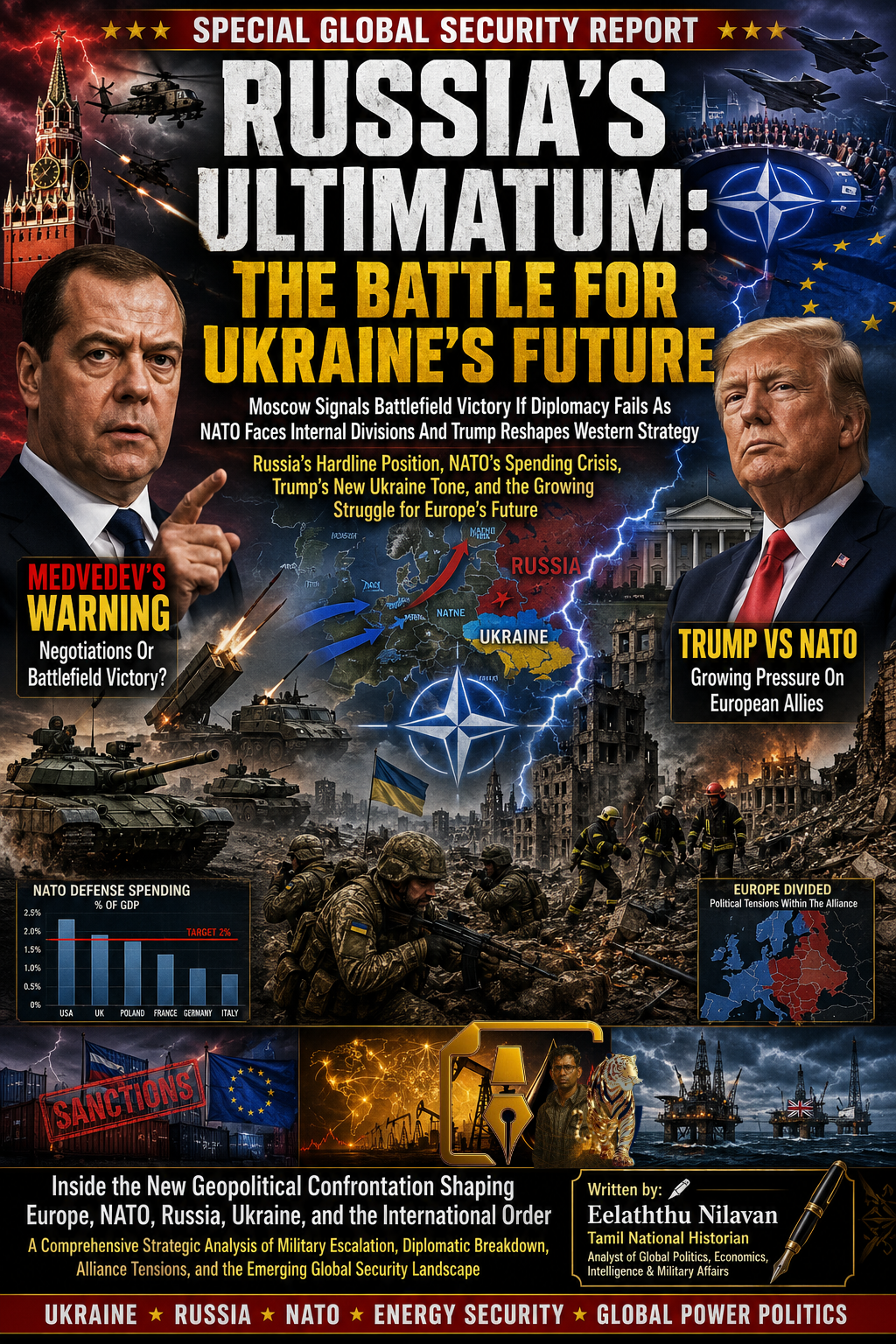

Moscow Signals That the Future of Ukraine May Be Decided on the Battlefield as Diplomacy Falters
A New Phase in the Ukraine War Emerges
The war in Ukraine has entered another critical stage as senior Russian officials deliver increasingly uncompromising messages regarding Moscow’s strategic objectives. Recent statements by Dmitry Medvedev, Deputy Chairman of Russia’s Security Council and former Russian President, have underscored the Kremlin’s growing belief that military developments on the battlefield may ultimately determine the outcome of the conflict.
While Russian officials continue to state that negotiations remain theoretically possible, their language suggests diminishing confidence in diplomacy. Instead, Moscow appears to be emphasizing military strength, national mobilization, and battlefield success as the primary guarantees of Russia’s security and geopolitical objectives.
At the same time, developments in Washington, Brussels, and European capitals reveal widening debates over NATO’s future role, military spending commitments, support for Ukraine, and broader energy security concerns. Together, these issues are reshaping the geopolitical landscape of Europe and the wider international order.
Medvedev’s Battlefield Doctrine: Negotiation or Military Victory
In one of his strongest public statements in recent months, Dmitry Medvedev argued that Russia is prepared to achieve its objectives either through negotiations or through military force if diplomatic efforts fail.
According to Medvedev’s position, Russia cannot rely solely on signed agreements or political promises. Instead, he contends that the country’s strongest guarantees lie in military readiness, strategic deterrence, economic resilience, and national unity.
This rhetoric reflects a broader Kremlin narrative that views diplomacy and military operations as interconnected tools rather than separate alternatives. From Moscow’s perspective, negotiations are meaningful only when they reflect realities established on the battlefield.
Russian officials increasingly portray the conflict as a long-term strategic contest in which endurance, industrial capacity, military production, and political stability may ultimately prove more decisive than diplomatic initiatives.
The Controversy Over Ukraine’s Political Legitimacy
One of the most controversial aspects of Medvedev’s remarks concerns his challenge to the legitimacy of Ukraine’s current leadership.
Ukraine has remained under martial law since Russia’s full-scale invasion, leading to the suspension of national elections under wartime constitutional provisions. Ukrainian authorities argue that holding nationwide elections during active conflict would be practically impossible and could undermine national security.
However, Russian officials have increasingly used the postponement of elections to question the constitutional authority of President Volodymyr Zelensky’s administration.
Medvedev argues that prolonged wartime conditions have created uncertainty regarding future agreements signed by Kyiv. Russian officials suggest that any future settlement would require exceptionally strong legal mechanisms and guarantees.
Ukraine and its Western allies strongly reject these claims, maintaining that wartime legal provisions fully support the continuation of constitutional governance until conditions permit democratic elections.
This disagreement has become another major obstacle to potential peace negotiations.
Nuclear Warnings and Strategic Messaging
Another significant aspect of Medvedev’s comments involved nuclear deterrence and Western military support for Ukraine.
While Russian officials insist that Moscow is not seeking nuclear confrontation, they continue to warn against what they view as dangerous escalation by NATO countries.
These warnings serve multiple strategic purposes.
First, they reinforce Russia’s status as a major nuclear power capable of defending its interests against external pressure.
Second, they aim to influence public opinion within Europe by highlighting the potential risks of a prolonged confrontation between Russia and NATO.
Third, they signal that Moscow views certain Western actions as crossing strategic red lines.
Western governments have consistently maintained that their support for Ukraine is defensive in nature and intended to preserve Ukrainian sovereignty rather than provoke direct conflict with Russia.
Nevertheless, nuclear rhetoric remains an enduring feature of the geopolitical environment surrounding the war.
NATO Faces Growing Pressure and Internal Questions
As Russia continues its military campaign, NATO faces increasing scrutiny regarding burden-sharing, military readiness, and long-term support for Ukraine.
Recent discussions involving U.S. President Donald Trump and NATO Secretary General Mark Rutte highlighted ongoing tensions over defense spending commitments.
Trump reiterated his longstanding criticism that many NATO members rely excessively on American military capabilities while failing to contribute proportionately to collective defense.
The debate centers largely around ambitious defense spending targets that many European governments are still struggling to meet.
While countries such as Poland, the Baltic states, and several Nordic nations have significantly increased military expenditures, larger Western European powers face political and economic challenges in rapidly expanding defense budgets.
The discussion reflects broader questions about the future balance of responsibilities within the alliance.
Trump’s Evolving Position on Ukraine
One of the more notable developments has been Donald Trump’s recent shift in tone regarding Ukrainian President Volodymyr Zelensky.
After years of often critical remarks, Trump publicly described Zelensky as courageous and acknowledged Ukraine’s ability to continue resisting Russian military pressure despite enormous challenges.
This change in rhetoric has attracted significant international attention because it may indicate a more nuanced approach toward the conflict.
At the same time, Trump continues to emphasize that European nations should assume greater responsibility for supporting Ukraine and funding regional security initiatives.
NATO officials are therefore attempting to develop mechanisms that maintain military assistance to Kyiv while addressing concerns about burden-sharing among alliance members.
NATO’s New Weapons Supply Strategy
A major focus of current alliance planning involves ensuring a sustainable flow of weapons, ammunition, and air-defense systems to Ukraine.
Officials have discussed arrangements under which European governments and Canada would finance military procurement while American defense manufacturers provide equipment.
Such frameworks seek to satisfy several objectives simultaneously.
They help maintain Ukrainian military capabilities, support Western defense industries, and address political concerns regarding the distribution of financial responsibilities among NATO members.
As the war continues, sustaining ammunition production and replenishing military stockpiles have become critical strategic priorities across the alliance.
Trump’s North Sea Energy Challenge to Britain
Beyond Ukraine and NATO, Trump has also generated headlines with his criticism of Britain’s energy policies.
Arguing that the United Kingdom has failed to fully utilize North Sea energy resources, Trump claimed that reopening and expanding offshore oil production could provide substantial economic benefits.
He contrasted Britain’s current situation with Norway’s highly successful management of North Sea energy wealth through its sovereign wealth fund.
The debate reflects broader tensions between energy security, economic growth, climate commitments, and environmental sustainability.
Supporters of expanded North Sea drilling argue that domestic production enhances energy independence and strengthens economic resilience.
Critics counter that long-term investments should focus on renewable energy infrastructure rather than increased fossil fuel extraction.
The issue is likely to remain a central political and economic debate for years to come.
Russia’s Broader Challenge to the Western-Led International Order
Beyond military issues, Medvedev’s remarks also represent a broader ideological challenge to what Moscow describes as a Western-dominated international system.
Russian officials argue that international institutions increasingly serve the interests of a limited group of powerful states rather than operating according to universal principles of sovereign equality.
Moscow continues to criticize sanctions, asset freezes, and financial restrictions imposed by Western governments.
Russian leaders characterize these measures as politically motivated economic warfare rather than legitimate international legal actions.
Western governments reject this interpretation, arguing that sanctions are lawful responses to Russia’s military actions in Ukraine and violations of international norms.
This dispute reflects a much larger global struggle over the future structure of international governance, economic power, and geopolitical influence.
What Happens Next?
The coming months may prove decisive for several reasons.
Military operations on the battlefield continue to shape negotiating positions.
NATO is reassessing its defense posture and spending priorities.
The United States faces important decisions regarding future sanctions and military assistance.
European governments are balancing security requirements with economic pressures.
Meanwhile, Russia appears determined to sustain both military and political pressure while pursuing strategic objectives it considers essential to national security.
Whether the conflict ultimately moves toward negotiations, prolonged stalemate, or intensified confrontation remains uncertain.
What is increasingly clear, however, is that the war in Ukraine has evolved into far more than a regional conflict. It has become a defining struggle over security, power, economic influence, and the future structure of the international system itself.
Conclusion
The latest statements from Dmitry Medvedev reveal a Russia that is increasingly confident in pursuing its objectives through military means if diplomacy fails. Simultaneously, debates within NATO, changing signals from Washington, and growing concerns over European security and energy policy illustrate a rapidly evolving geopolitical landscape.
As battlefield realities continue to influence diplomatic possibilities, the world watches a conflict whose consequences extend far beyond Ukraine’s borders. The decisions made in Moscow, Kyiv, Washington, Brussels, and major European capitals during the coming months may shape global politics, security architecture, and international relations for decades to come.
𝐖𝐫𝐢𝐭𝐭𝐞𝐧 𝐛𝐲: